A manufacturer builds its brand to be on the buyer’s shortlist before the buyer asks for quotes. In B2B, 92% of buyers choose a supplier from the list they started with. Whoever is missing from it loses the order before a request for proposal exists. Manufacturers are the largest group in the INOVEO archive, and the work they commission forms a complete package, with the emphasis on the materials that end up in the buyer’s hands.
Which industries invest most often in their brand?
By main activity (NACE section), manufacturing accounts for 23% of INOVEO clients. Trade follows with 22%, professional services with 13%, ICT and media with 10%, finance with 6% and construction with 5%. Hospitality, healthcare, real estate and support services have 3% each, and other industries add up to 9%.
Source: INOVEO project archive 2007-2026
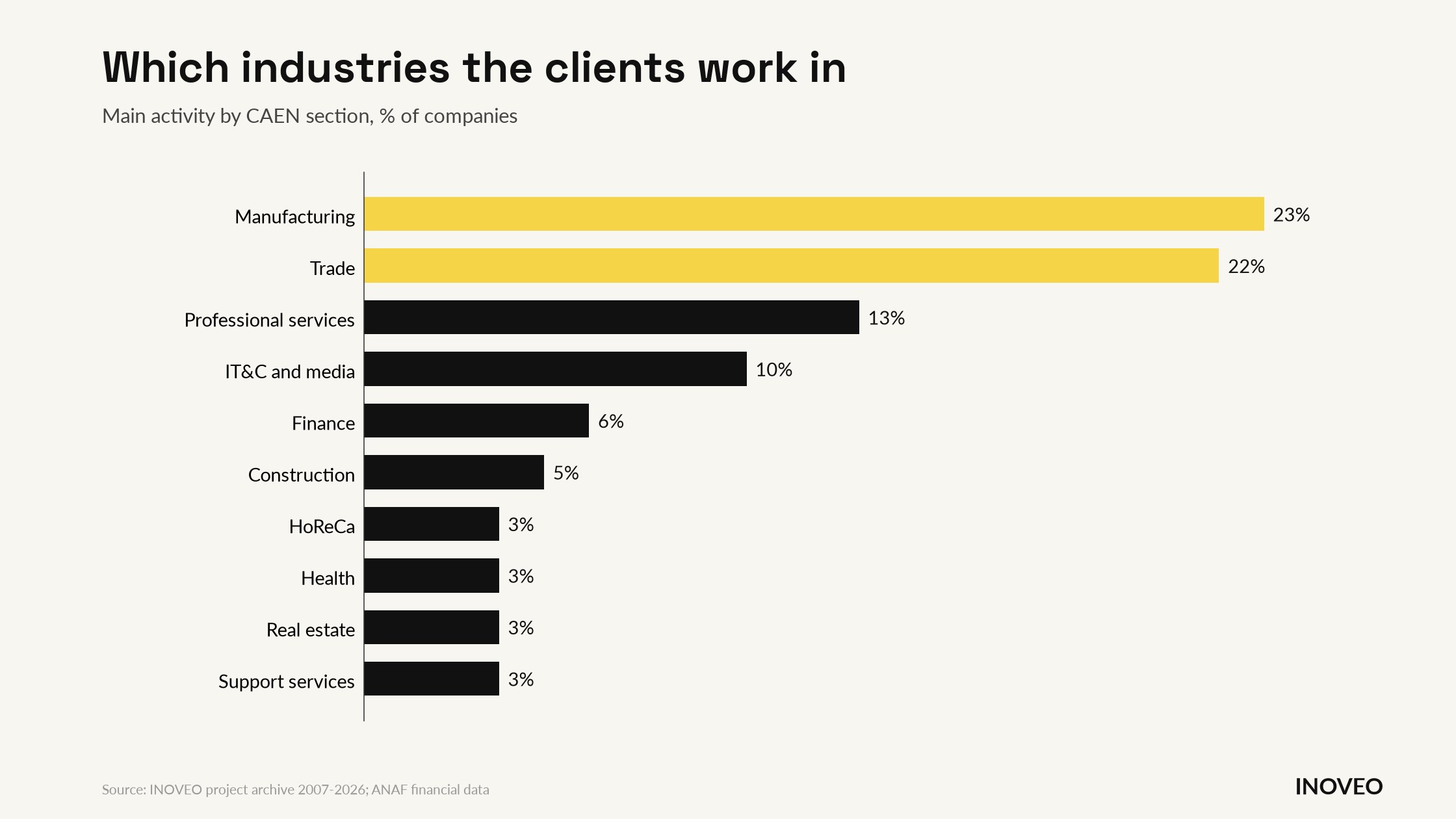
Manufacturers come slightly ahead of trade. The usual picture says otherwise: branding would be for shops, cafés and shelf products. In reality, the component factory, the office furniture maker and the company that extrudes aluminium profiles need a brand just as much. The difference is in who sees it.
An example from the plastics industry is Bavaria Plastics. The rebrand covered analysis and audit, the brand platform, the visual identity, the brand guidelines, implementation and online presence. A manufacturer thus received the argument first and then the signs that carry it.
Why does the buyer’s shortlist matter?
The industrial buyer reaches the request for proposal with the names already in mind. A Bain and Google study of 1,208 B2B buyers, quoted by the LinkedIn B2B Institute, shows that 86% start the purchase with a “Day One” list already formed, and 92% eventually choose a supplier from that list. Ehrenberg-Bass research from 2022-2023, quoted in the same document, shows that a B2B buyer considers 2.8 brands on average.
Think about what this means for a manufacturer. If you are fourth on the buyer’s list, you lose the order before a request for proposal exists. Product quality matters at the end, when the buyer chooses among the three on the list. The brand matters at the beginning, when the list is made.
What does a manufacturer gain from a strong brand?
McKinsey compared B2B companies with strong and weak brands. In 2012, those with strong brands had an EBIT margin 20% higher, compared with 13% in 2011. The study shows a correlation: well-run companies also have good brands. For a manufacturer, the practical lesson is different: margin is easier to defend when the customer chooses you by name, ahead of price.
Homburg, Klarmann and Schmitt (2010), in the International Journal of Research in Marketing, studied more than 300 B2B companies across several industries. Brand awareness had a significant influence on their market performance. The effect depended on the market and the buyer: product homogeneity, the pace of technological change, how many people decide and how much time they have. The situation common among Romanian manufacturers, with similar technical specifications and purchases made under deadline pressure, is exactly the kind of context the study describes.
Why is pressure rising for Romanian manufacturers?
Eurostat data shows that manufacturing accounted for 14.6% of Romania’s gross value added in 2025, against an EU average of 15.8%, down from 15.5% in 2022. Measured as a share of GDP, the decline is even more visible: the European Commission’s 2026 country report shows a fall from 20% in 2016 to 11.9% in 2025, and the automotive industry represents about 50% of manufacturing.
The slice is shrinking, and the remaining manufacturers compete for it. Many depend on the same automotive chain. Those with a name of their own, recognised by buyers in several industries, also have more doors open when a large customer moves its production.
Here the brand becomes insurance. A supplier known to a single buyer depends on that buyer’s decisions. A supplier with a name in the industry also gets calls from companies it would be working with for the first time.
What branding work do manufacturers commission?
Among manufacturers, strategy appears for 52% of clients, compared with 47% overall. Manufacturers are the only group in which print and editorial (57%) exceeds visual identity (52%). Website work appears at 48%, compared with 35% overall. Naming appears least often, at 14%, compared with 26% overall.
Source: INOVEO project archive 2007-2026
| Work | Manufacturers | All clients with a detailed file |
|---|---|---|
| Strategy and positioning | 52% | 47% |
| Print and editorial | 57% | 45% |
| Visual identity | 52% | 58% |
| Website and digital | 48% | 35% |
| Naming | 14% | 26% |
Source: INOVEO project archive 2007-2026
The picture makes sense. A manufacturer already has its name, often for decades. It needs a strategy that says why it should be chosen, then the tools the technical buyer actually uses: the catalogue, the data sheet, the trade fair presentation, the website with specifications. Manufacturers commission the complete package: strategy, printed materials, website, brand guidelines and campaigns, linked together.
Where does the analysis stop?
- The industry is the one in the main NACE code. A company can both manufacture and sell.
- Clients without a NACE code (foreign or unidentified companies) appear only in the total.
- The McKinsey and Bain studies show correlations and come from large markets. They describe the direction, and exact figures differ from one market to another.
What decision can you make now?
Call three buyers who already work with you and ask them: “When you need a new supplier in our field, who do you call first?” Write down the names in the order they say them.
Then open your catalogue, data sheet and website and read them as a buyer comparing you with two competitors. If the texts talk only about machinery and certifications, you have found the work: the strategy that says why you, written into every material.
Frequently asked questions
What is industrial branding?
It is brand building for companies that sell physical products to other companies: components, materials, equipment. The audience is engineers, buyers and directors, who decide for the long term.
Does a manufacturer need a new visual identity?
Sometimes. More often it needs strategy and consistent materials. Among manufacturers in the INOVEO archive, print and editorial (57%) appears more often than visual identity (52%).
Source: INOVEO project archive 2007-2026
How do you get onto the buyer’s shortlist?
Through consistent presence before the request: a name recognised in the industry, useful materials, people visible at trade fairs and in the trade press. According to Ehrenberg-Bass, the buyer considers 2.8 brands on average.