A new company needs the foundation of its brand from the start: a good name, clear positioning and a simple visual identity. The complete system is built once the company has confirmed its market. The most expensive thing to postpone is the name: today it costs a check, ten years from now it costs the recognition you have earned with customers. In the INOVEO archive, clients came to their first project at very different ages, and the median is 11 years.
At what age do companies reach their first brand project?
26% of INOVEO clients were 0-4 years old at their first project, 21% were 5-9 years old, 27% were 10-19 years old and 26% were over 20. The median is 11 years.
Source: INOVEO project archive 2007-2026; ANAF data
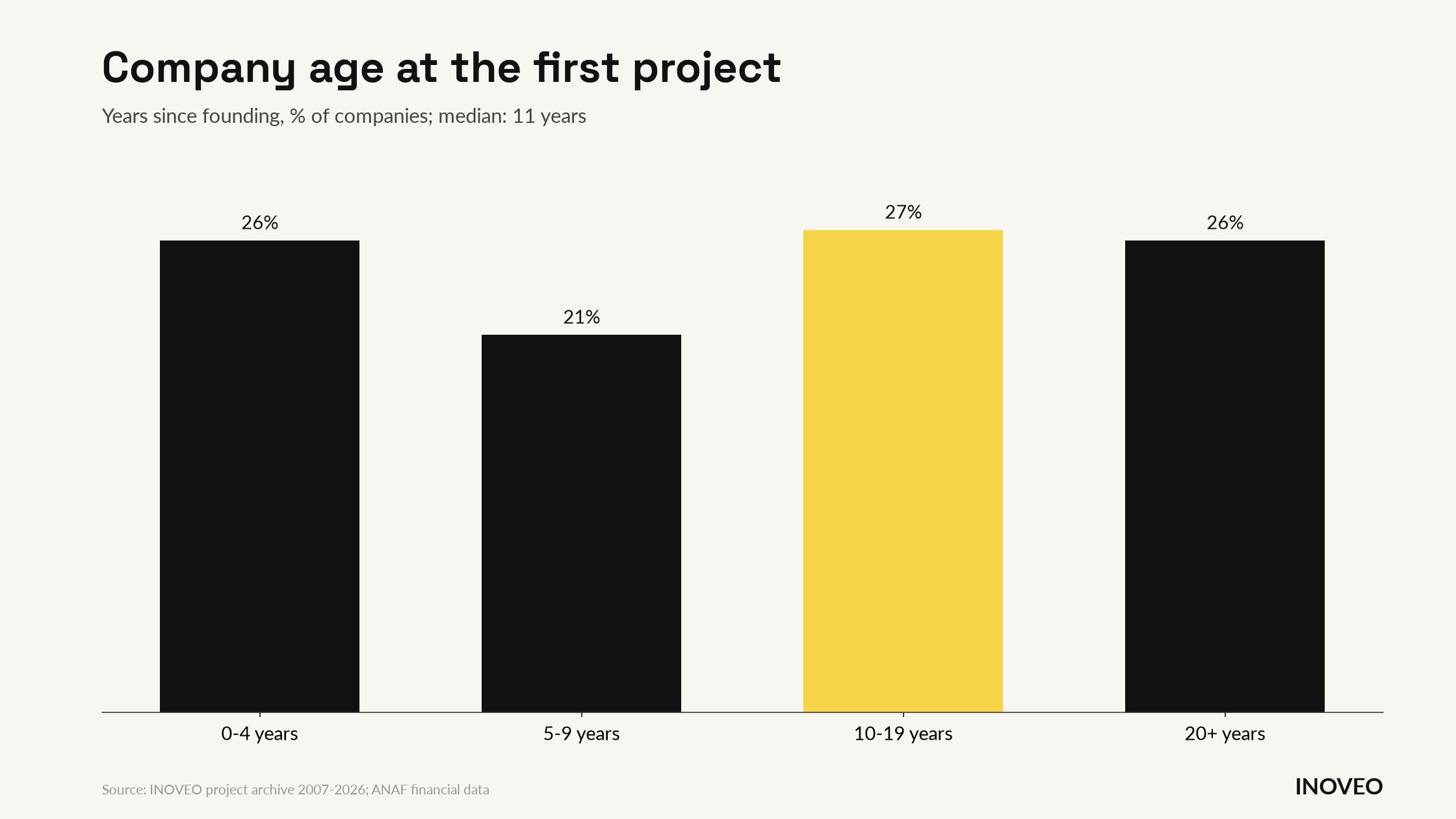
26% of companies come in their first four years. 53% come after ten years in business. Many of them reach a brand project to put order into what was built in a hurry at the start: a name chosen in one evening, a visual identity made by a friend, a website rebuilt three times.
An example of a brand built from the name up is Dumbrawa, in the raw vegan space. The work started from analysis and the brand platform and included the name, the visual identity, implementation and the website. These are exactly the pieces that stay valid however the company evolves.
Why do new companies close?
CB Insights analysed 431 venture-backed startups that closed from 2023 onwards. 70% ran out of capital, 43% had a product without market fit, 29% entered the market at the wrong time and 19% had unsustainable unit economics.
The brand is missing from the list, and it is fair to say so. The lack of a brand rarely closes a company. Positioning, however, is the product-market fit question seen from the customer’s side: whose problem do you solve, better than anyone else? A company that writes its positioning in its first year tests earlier exactly the hypothesis that decides 43% of closures.
There is one more thing. 70% of the companies in the study ran out of capital. Investors, banks and partners more readily finance a company that can clearly explain its market, its customer and its difference. Clear positioning, written in the first year, also helps in the conversation with them. The study measures capital, and the link with the brand remains a common-sense observation.
How long do new companies last in Romania?
Eurostat data for Romanian companies founded in 2015 shows that 88.1% were active after one year, 65.33% after three years and 49.88% after five years. For 2024, the three-year survival rate in Romania is 59.14%, above the EU average of 57.18%, while the one-year rate fell to 77.85%, below the EU average of 80.52% (Eurostat).
About 50% of new companies pass five years. This gives a practical rule. In the first year, you invest in the brand pieces that stay valid however the company evolves. The large system, with full guidelines, campaigns and architecture, you build once you know for sure what you sell and to whom.
What do you do at the start and what do you leave for later?
| Company age | Share in the archive | What you do | Why now |
|---|---|---|---|
| 0-4 years | 26% | Legally checked name, positioning sentence, basic visual identity, simple website | The name is the hardest thing to change later |
| 5-9 years | 21% | Brand strategy, clear offer, sales materials | The market is confirmed, the team is growing |
| 10-19 years | 27% | Rebranding, brand guidelines, employer brand | The company has outgrown its original identity |
| Over 20 years | 26% | Brand architecture, succession, governance | Several brands, the second generation, acquisitions |
Source: INOVEO project archive 2007-2026; ANAF data
Rode and Vallaster (2005), in Corporate Reputation Review, followed how the brand takes shape in the first years of new companies. Their conclusion: in a new company, the brand is born from the founder’s decisions about culture, behaviour, design and communication, long before there is a marketing department. The brand therefore exists from the first year. What remains to choose is whether you build it with intent.
Which part of the brand costs most if you postpone it?
The name. A visual identity can be refined in a few months. A name changed after ten years means documents, registrations, contracts, email addresses, packaging and, above all, the recognition you lose with customers. Check the name legally, as a trademark and as a domain, in the very first month.
The second piece is the positioning sentence. It costs only time and an honest discussion between the founders. Companies that write it early make product, pricing and hiring decisions more easily.
The third piece is visual discipline. A simple identity, used the same way on the website, the invoice and the presentation, builds recognition from day one. Ten improvised variants over the years cost more than an identity done well from the start.
Where does the data stop?
- The age is the one at the first project with INOVEO. Some companies had worked on their brand earlier with other suppliers.
- The archive includes the companies that reached a project. Companies that closed earlier are missing from it, so the data describes survivors.
- The CB Insights study looks at venture-backed startups, mostly in the US.
What decision can you make now?
If your company is under four years old, write a single sentence with your partners today: “For [whom], we are [what] that [what the customer gets], unlike [their alternative].” If you argue over every bracket, you have found the question to work on before any visual identity.
If the company is over ten years old, put everything it communicates today on the table: website, offer, presentation, packaging, careers page. Check whether they tell the same story.
Frequently asked questions
Is it worth investing in the brand before the first customers?
It is worth investing in the name, the positioning and a simple visual identity. You build the rest once your first customers confirm what they buy from you.
Can I change the visual identity later?
Yes. A visual identity can be refined as the company grows. The name is much harder to change, which is why it deserves careful checking from the start.
At what age do companies do their first brand project?
It varies widely. The median INOVEO client was 11 years old, and 26% came in their first four years in business.
Source: INOVEO project archive 2007-2026; ANAF data