Brand accounts for 32% of the purchase decision in technology and 67% in luxury, according to Interbrand. That is why each industry asks something different of its brand, depending on where and how fast its customer decides. In the INOVEO archive, manufacturers worked mainly on strategy and printed materials, retail on visual identity and naming, and professional services on visual identity. Money put into the work that suits the industry works at the moment of decision; the rest works in a vacuum.
What work do different industries ask for?
The map of requests in the INOVEO archive shows clear profiles. Manufacturers worked mainly on strategy (52%, against 47% overall) and on print and editorial (57%). Naming appears least often among them, at 14%, against 26% overall. Retail worked mainly on visual identity (67%, against 58% overall) and on naming (33%).
Source: INOVEO project archive 2007-2026
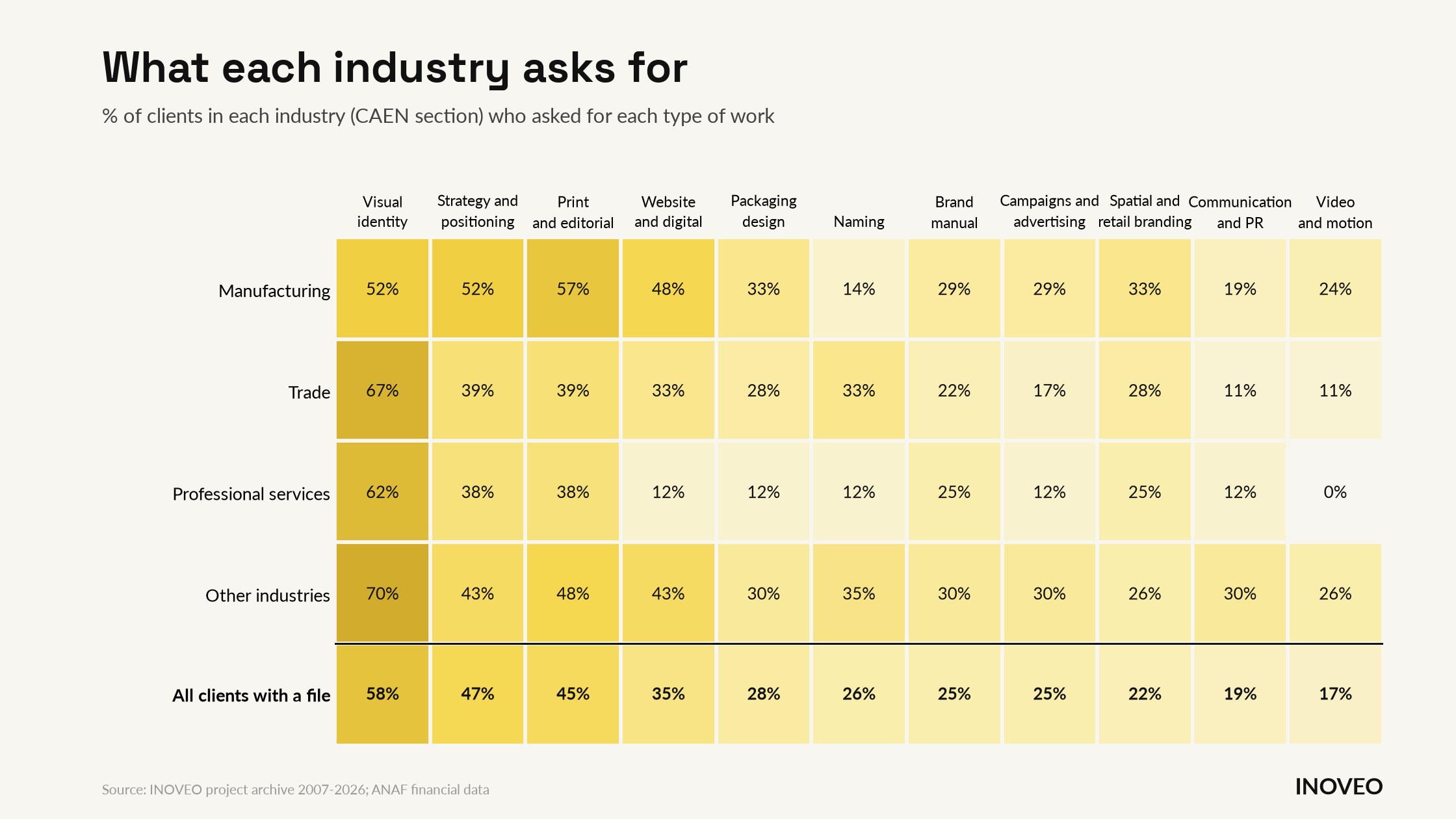
In professional services, visual identity dominates, at 62%. Website, packaging, naming and campaigns each appear at 12%, and video is absent altogether. In the “other industries” group, visual identity reaches 70%, and communication and PR 30%, against 19% overall.
Source: INOVEO project archive 2007-2026
In the pharmaceutical industry, one example is Biofarm. The rebrand covered analysis and audit, the brand platform, the visual identity, implementation, online presence, the website and the brand guidelines. The profile shows a complete system, suited to an industry where trust is built over the long term. See the Biofarm project.
Why do industries ask for different things?
The most likely explanation lies in the moment when the customer decides. The brand works exactly at that moment, and the work requested follows the place and speed of the decision. The archive figures show what was requested; the link with the moment of decision is our interpretation.
In retail, the customer decides in front of the shelf or the shop window, in a few seconds. Visual identity and the name do all the work. This fits 67% visual identity and 33% naming: retail often launches new brands, stores and products, each needing its own name and sign.
Among manufacturers, the buyer decides after months of evaluation, with technical specifications on the table. The name usually exists for many years. What is often missing is the written argument and the material that carries it. Hence strategy and print.
In professional services, the client buys trust before seeing the result. Visual identity becomes the first signal of seriousness, at the first meeting and on the first page of the proposal.
In the “other industries” group, communication and PR rise to 30%. This includes companies in fields such as energy, transport, education or agriculture, where public reputation and the relationship with authorities weigh heavily. For them, the brand is also built through what the press, partners and the community say.
How much does brand count in decisions, by industry?
Interbrand measures the share of the purchase decision attributed to the brand, separate from price and features. In 2019, the role of brand was 32% in technology, 60% in beverages and 67% in luxury. The gap between sectors is more than double. For a luxury perfume, the brand does almost everything. For a laptop, the buyer first compares the processor, memory and price, and the brand decides between the remaining models.
The 2025 study by Interbrand and Paradigm Sample, based on 5,500 evaluations from the US, Germany, India, China and Brazil, shows that the average role of brand fell to 33%, from 38% in 2019 (Role of Brand Report 2025, PDF). When brand weighs less on average, it matters even more to place it exactly where your customer decides.
In B2B, too, the weight of brand differs by sector. A McKinsey survey of about 700 B2B decision-makers in Germany, India and the US shows that brand matters most for machinery and components, moderately for chemicals and raw materials and less for financial services and utilities.
Fischer, Völckner and Sattler (2010), in the Journal of Marketing Research, measured how important the brand is to decisions across 20 product categories and five countries, with more than 5,700 consumers. The importance of brand varied substantially from one category to another and from one country to another. The useful question for any company therefore becomes “how much does brand count in my category?”.
What does the map look like, in short?
| Industry | Most requested work | What stands out against the total |
|---|---|---|
| Manufacturing | Print and editorial, 57% | Strategy 52%; naming only 14% |
| Retail | Visual identity, 67% | Naming 33% |
| Professional services | Visual identity, 62% | Website, packaging, naming, campaigns at 12% each |
| Other industries | Visual identity, 70% | Communication and PR 30% |
| All clients | Visual identity, 58% | Strategy 47% |
Source: INOVEO project archive 2007-2026
Where does the analysis stop?
- The industry is the one in the company’s main CAEN (Romanian activity classification) code. Clients without a CAEN code (foreign or unidentified companies) appear only in the total.
- The professional services row has a small base and should be read as a trend.
- Interbrand measures global consumer brands. The figures show the order of magnitude, and for Romanian B2B the proportions may differ.
What decision can you make now?
Ask yourself the question your industry asks: where and how fast does your customer decide? If they decide in a few seconds, invest first in visual identity and the name. If they decide after months of evaluation, invest first in strategy and in the materials they read. If they buy your trust, invest in the signals that show it from the first contact.
Then look at what your direct competitors do and find the work they all do the same way. That is your space for differentiation.
Frequently asked questions
Does brand count equally in all industries?
It varies a lot. In 2019, Interbrand measured a role of brand of 32% in technology and 67% in luxury. In B2B, McKinsey shows that brand matters most for machinery and components.
What branding work do retail companies ask for most often?
Visual identity, at 67% of INOVEO retail clients, followed by naming, at 33%.
Source: INOVEO project archive 2007-2026
What do professional services firms ask of their brand?
First of all visual identity, as a signal of trust at first contact: 62% of INOVEO professional services clients asked for it.
Source: INOVEO project archive 2007-2026