Small companies ask branding for a clear identity, while large companies ask for a system that keeps it the same in dozens of places. In the INOVEO archive, companies with revenue above 250 million lei asked for brand guidelines in 44% of cases, against 14% among companies below 10 million. Strategy also rises with size, from 36% to 56%. For a growing company, the signal is clear: the system gets built before the brand reaches too many hands.
What do companies ask for differently, by size?
Across three revenue bands, strategy appears for 36% of companies below 10 million lei, 48% of those between 10 and 250 million and 56% of those above 250 million.
Source: INOVEO project archive 2007-2026; ANAF financial data
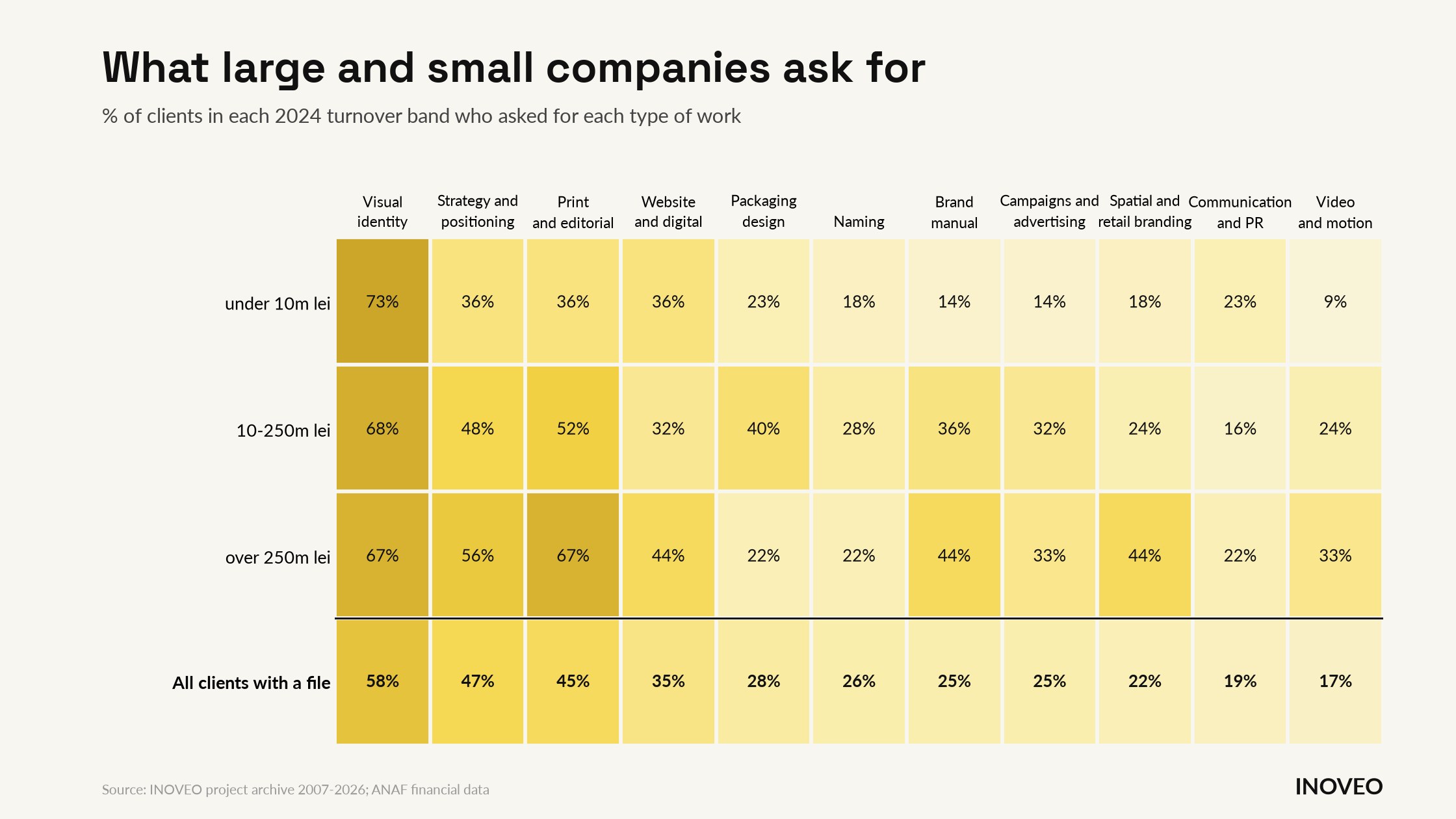
The big differences appear in system work. Companies above 250 million lei asked for print and editorial in 67% of cases, against 36% among companies below 10 million. Brand guidelines appear at 44%, against 14%. Spatial and retail branding appears at 44%, against 18%. Video and motion appears at 33%, against 9%.
Source: INOVEO project archive 2007-2026; ANAF financial data
The difference shows when you place two projects side by side. For BNR, the National Bank of Romania, a public institution, the rebrand included the brand platform, the visual identity, implementation, online presence and the brand guidelines. For Imacoolat, a dry-cleaning business, the work started from the name, visual identity, packaging and website, the foundation a smaller company needs. See the BNR project.
At the other end, companies below 10 million lei most often ask for visual identity: 73%, against 67% among large companies. The middle band, 10-250 million, most often asks for packaging design: 40%, against 28% overall.
Source: INOVEO project archive 2007-2026; ANAF financial data
Why do large companies ask for more system?
Because their brand lives in more hands. A small company has one website, one offer and a few materials, controlled by two or three people. A large company has dozens of points of sale, hundreds of employees, material suppliers in several cities and teams that give presentations every day. Without guidelines, everyone interprets the brand in their own way, and the customer receives dozens of versions of the same company.
There is also volume. 56% of companies above 250 million lei asked for at least three types of work, against 45% of those below 10 million.
Source: INOVEO project archive 2007-2026; ANAF financial data
Wong and Merrilees (2005), in the Journal of Product & Brand Management, describe a ladder of brand orientation in SMEs: minimal, embryonic, integrated. According to them, most small firms sit on the lower rungs. The INOVEO archive shows the same ladder, read through the work requested: the more a company grows, the more system it asks for.
How much do large companies spend on marketing?
Gartner shows that in 2025, the marketing budget stayed at 7.7% of revenue, the same as in 2024. The survey covered 402 marketing leaders from North America, the UK and Europe, most of them from companies with revenue above one billion dollars. 59% say the budget is insufficient, and 39% plan to cut agency budgets.
The benchmark concerns large companies in other markets. Budget pressure makes the system even more valuable: good guidelines and clear rules allow a company to produce more in-house, with fewer agencies.
What base do small Romanian companies have?
Eurostat data for 2025 shows that 51.0% of small companies in Romania (10-49 employees) have a website, against 75.4% of large companies (250+). The EU average is 76.7% for small companies and 95.7% for large ones. Overall, 53.6% of Romanian companies with more than 10 employees have a website, against 79.0% in the EU.
On social media, the gap is similar. In the EU, in 2023, 58% of small companies used social media, against 86% of large ones, while in Romania the overall share was 40.5%. In the EU, company blogs appear at 8.4% of small companies and 33.4% of large ones (Eurostat).
Small Romanian companies sit about 26 percentage points below the European average for online presence. For a customer looking for a supplier, a company without a website drops off the shortlist before the first phone call. For a small company, the gap is an opportunity: a good website, tied to a clear identity, immediately lifts it out of the group of companies that are hard to find.
What do the differences look like, in short?
| Work | Below 10m lei | 10-250m lei | Above 250m lei |
|---|---|---|---|
| Strategy and positioning | 36% | 48% | 56% |
| Visual identity | 73% | · | 67% |
| Print and editorial | 36% | · | 67% |
| Brand guidelines | 14% | · | 44% |
| Spatial and retail branding | 18% | · | 44% |
| Video and motion | 9% | · | 33% |
| Packaging design | · | 40% | · |
Source: INOVEO project archive 2007-2026; ANAF financial data. The “·” sign marks values that fall outside this comparison.
Where does the analysis stop?
- The band above 250 million lei has a very small base; its percentages should be read as a trend.
- Companies with zero revenue in 2024 and clients without public financial statements are missing from the bands.
- Revenue is from 2024, and the projects were sometimes carried out when the company was smaller.
- Gartner describes large companies in other markets; the 7.7% benchmark applies poorly to an SME.
What decision can you make now?
If your company is small, check three things: a clear visual identity, a website that uses it and a sentence that says why customers choose you. These are the foundation.
If your company is large, ask: who in the company can say, with authority, how the brand is used? If the answer hesitates, the next piece of work is the guidelines, together with a person responsible for them.
Frequently asked questions
What do small companies ask of branding?
First of all visual identity: 73% of INOVEO clients below 10 million lei asked for it. Strategy and materials follow, less often.
Source: INOVEO project archive 2007-2026; ANAF financial data
What do large companies ask for in addition?
System work: brand guidelines, spatial branding, video and printed materials in volume, plus strategy. Above 250 million lei, guidelines appear for 44% of INOVEO clients.
Source: INOVEO project archive 2007-2026; ANAF financial data
How much do large companies spend on marketing?
According to Gartner, the marketing budget of large companies in North America and Europe stayed at 7.7% of revenue in 2025.