About 73% of Romania’s economy is produced outside the capital, and the companies there have a brand argument that is hard to copy: the place they come from. In the INOVEO archive, 45% of clients are based outside Bucharest, led by Ilfov, Prahova, Sibiu and Galați. For a regional company, the gain comes from roots told well. The cost of waiting is simple: the first local competitor that works on its brand takes the free spot.
Where do the companies that invest in their brand come from?
By county of registered office, 49% of INOVEO clients are from Bucharest. Ilfov follows with 6%, Prahova and Sibiu with 5% each and Galați with 4%. The other clients come from other counties and from abroad.
Source: INOVEO project archive 2007-2026
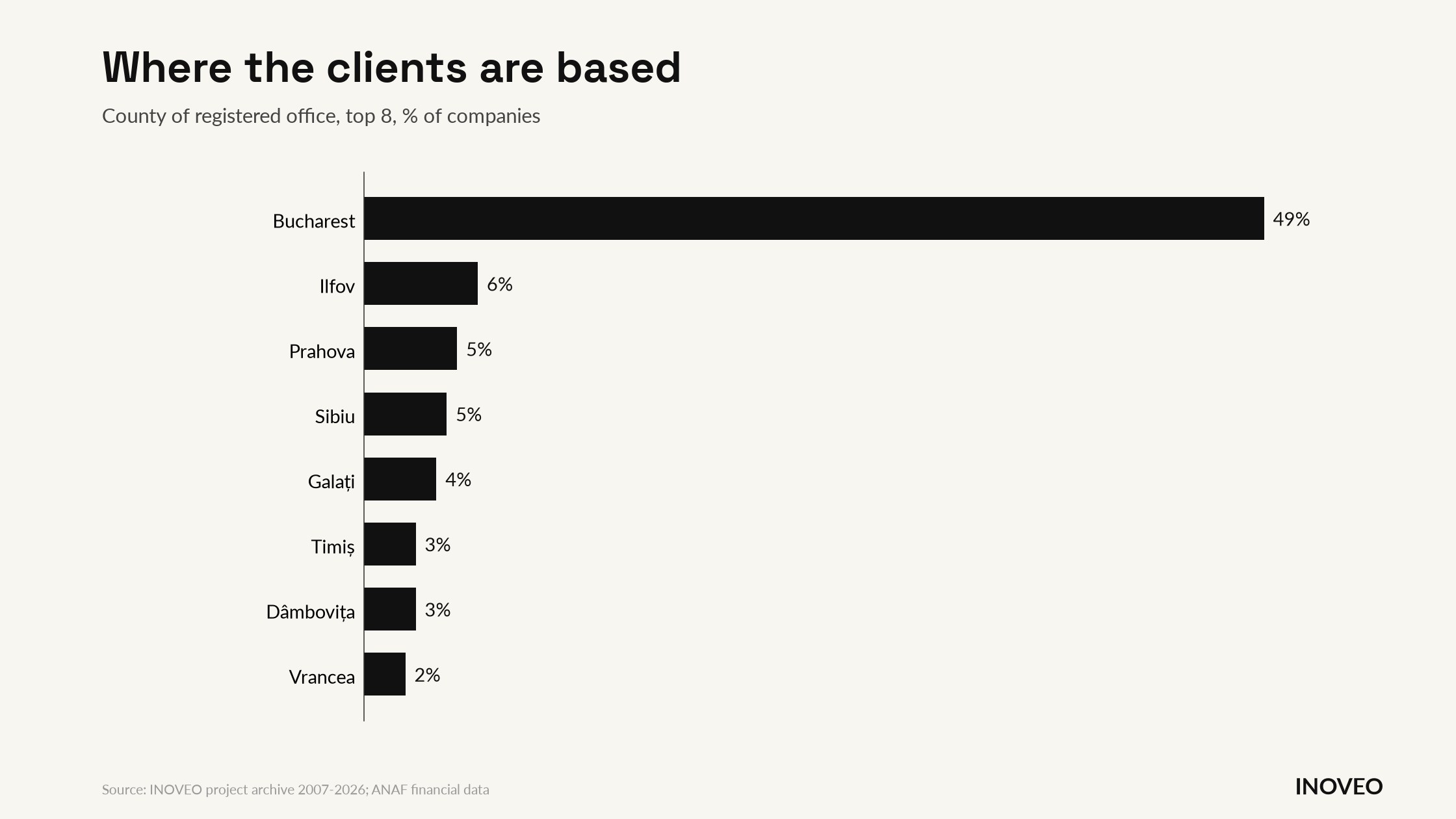
Bucharest dominates, as expected for an agency based in the capital. The interesting part is the rest: 45% of clients come from outside Bucharest. Companies from Sibiu, Prahova or Galați reached a brand project for the same reasons as those in the capital: competition, expansion, exports, a second generation in leadership.
An example of roots told well is Conacul Archia, a family business from Deva that revives Transylvanian values. The visual identity started from a monogram that translates the insignia of a noble family, drawn in a modern style with hand-painted letters. The origin of the place thus became the brand’s very argument. See the Conacul Archia project.
How much of the economy lies outside the capital?
About 73%. According to Eurostat, in 2018 the Bucharest-Ilfov region produced 27.3% of Romania’s GDP, and the other seven regions 72.7%. The wealth gaps are large: GDP per inhabitant, in purchasing power standards, was 152% of the EU average in Bucharest-Ilfov and 42% in the North-East.
The number of companies gives a similar picture. Based on data from the National Institute of Statistics (INS) published in the Romanian Statistical Review, about 24% of active enterprises in 2020 were based in Bucharest-Ilfov and about 76% in the rest of the country (calculation on INS data).
Put the two figures next to the archive. Bucharest and Ilfov account for 55% of INOVEO clients, although they hold about 24% of the country’s companies. Part of the difference comes from the agency being in Bucharest. The rest suggests an observation from practice: companies in the rest of the country ask for a brand project less often. For a regional company, this often means a more open field, with local competitors that have done little work on their brands.
Source: INOVEO project archive 2007-2026
Why do budgets differ from one region to another?
Because incomes differ. Eurostat shows that net primary income per inhabitant in Bucharest-Ilfov was, in 2023, 225.3% of the national average. Between 2019 and 2024, the region’s GDP grew by 33.0% (Eurostat).
The income gap largely explains why marketing budgets are smaller in many counties. The need for a brand stays the same. A manufacturer from Galați that sells in Germany is compared with German competitors. A retail chain from Prahova competes with the large national networks. Their buyers judge the brand by the same rules as in Bucharest.
Moreover, a regional company has an advantage that many companies in the capital have lost: a community that knows it. Employees are the customers’ neighbours, the local press follows it, the city hall invites it to events. A brand built on this closeness starts with trust already earned. The common mistake is to hide the origin in order to look “bigger”. The company then loses exactly the argument that a competitor from elsewhere finds hardest to imitate.
Van Ittersum, Candel and Meulenberg (2003), in the Journal of Business Research, showed that the image of the region of origin influences how people perceive and prefer a product. The effect works through concrete qualities: a region known for a craft raises trust precisely in the qualities linked to that craft. For a regional company, origin told well becomes an argument for quality.
What does a regional brand that grew nationally look like?
Dedeman. The company is based in Bacău and is the largest entrepreneurial company in Romania. According to an analysis by Termene.ro, Dedeman had revenue of about 12.3 billion lei in 2024, up 6%. That means about 21% of the revenue of the entire Bacău county, which totals 59.6 billion lei (calculation on Termene.ro data). Four local groups together account for 50% of the county’s revenue.
The Dedeman lesson: a head office outside the capital limits only the companies that think of themselves as local. A regional brand can become national if it keeps its roots and, at the same time, builds a name recognised everywhere.
What advantages does a regional company have?
| Advantage | What it means for the brand |
|---|---|
| Local roots | A real, verifiable story that is hard to copy |
| Community | Referrals, well-known employers, accessible local press |
| Local competitors with little brand work | Faster differentiation on smaller budgets |
| Lower costs | More budget available for consistency over time |
| Loyal people | An employer brand built on stability |
Where does the analysis stop?
- The county is that of the registered office. Many companies have factories, stores or customers in other counties.
- The archive belongs to a Bucharest agency, so the capital’s share is higher than in the market as a whole.
- The Eurostat data on regional GDP is from 2018, and the data on companies from 2020; the shares change slowly.
What decision can you make now?
Write down three things your company has thanks to the place where it was born: a craft, a resource, a community, a history. Then check whether they appear on the website, in the presentation and on the packaging.
If they are missing, you have found the material for your positioning. Local roots, told well, are an argument that a competitor from elsewhere can only imitate with great difficulty. Left untold, they remain available to the first local competitor that claims them.
Frequently asked questions
Is it worth a regional company working with a Bucharest agency?
It is worth working with an agency that understands the market where the company sells. The agency’s location matters less than its experience in the client’s industry and markets.
Can a regional brand become national?
Yes. Dedeman, based in Bacău, is the largest entrepreneurial company in Romania. Local roots can even be the basis of a national brand.
What share of the companies that invest in their brand are based outside Bucharest?
In the INOVEO archive, 45% of clients are based outside Bucharest.
Source: INOVEO project archive 2007-2026