A company of 10-250 people needs a brand so that it stays the same company as it grows. Up to 10 people, the founder explains everything personally. Past that threshold, the explanation travels through other people and changes a little with each one. The brand keeps it whole: for customers, for candidates and for the colleagues who sell in the founder’s place.
How many people work in the companies that invest in their brand?
In the INOVEO archive, 37% of clients are micro-enterprises, 28% are small companies, 23% medium-sized companies and 12% large companies. The median is 18 people.
Source: INOVEO project archive 2007-2026; ANAF financial data
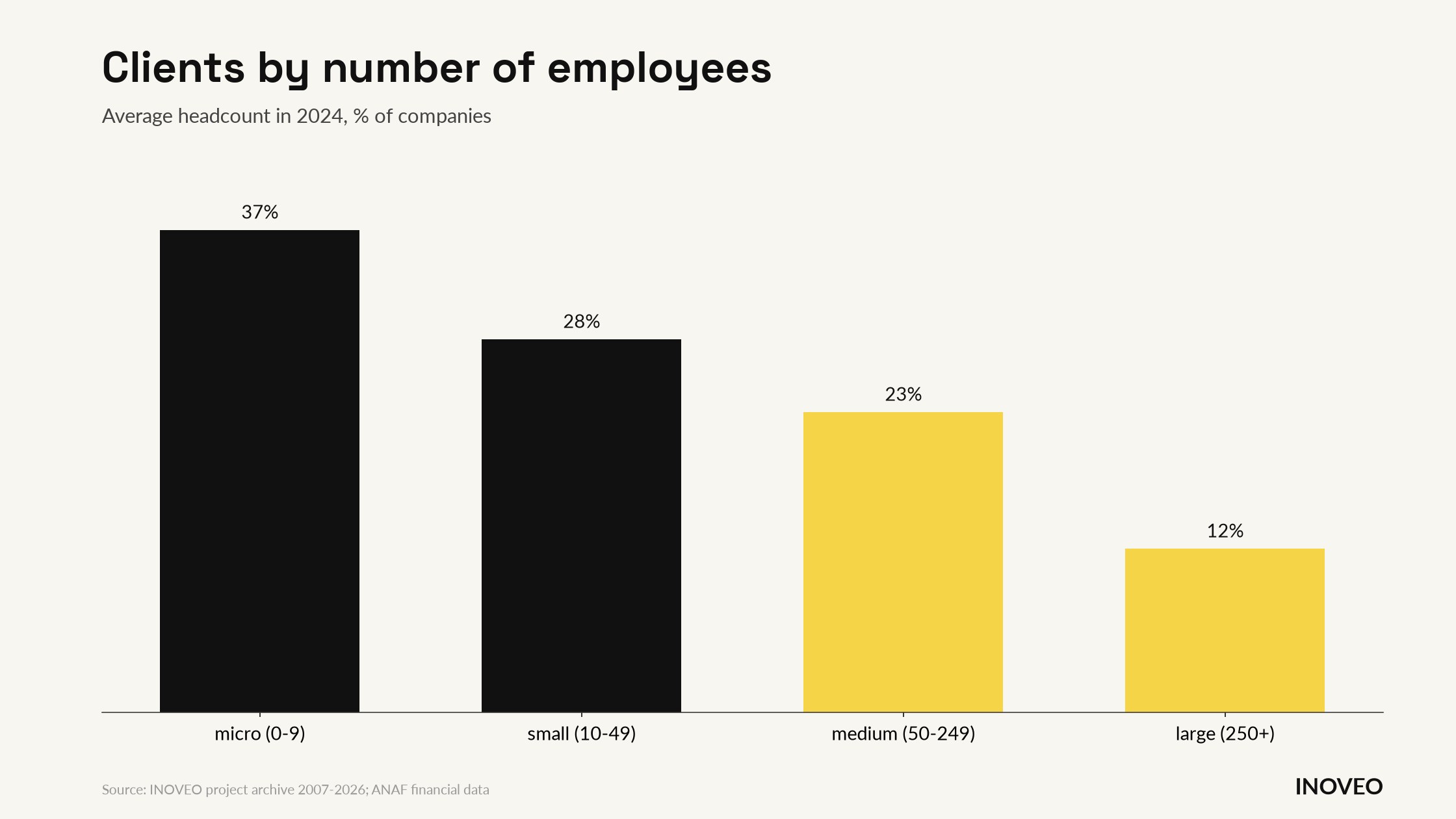
Add up the small and medium-sized companies and you reach 51% of clients. The median of 18 people says even more. The usual moment for a brand project is the one when the company has outgrown the table everyone used to sit around and has started hiring people who met the founder only at the interview.
Auto Total, a distributor of car parts, marked its 30th anniversary by going back to its essence. The INOVEO team ran workshops with the head office team, with senior staff and with regional and local agents, plus one-to-one interviews, to understand the company’s culture, language and mindset. The brand was built on what the people inside said, the very source an employer brand needs too. See the Auto Total project.
What changes when a company passes 10 people?
At 6 people, every colleague hears the company’s story directly from the founder, dozens of times. At 18, the story passes through two or three people before it reaches the new hire. Each tells it slightly differently. The salesperson stresses price, the engineer technology, the accountant payment terms.
The customer hears all three versions and draws a conclusion alone. Sometimes it is the right one. Often it is the cheapest: “They are like the others, just a bit more expensive.”
At this size, the brand is the shared version of the story. A positioning sentence anyone in the company can repeat, three or four arguments with proof, the same visual identity on the offer, on the truck and on the careers page.
The cost of its absence shows up in money. Every offer lost on price, every customer who asks for one more meeting “to understand what you do”, every new hire who needs months to explain the company the way the founder does. At 18 people, these costs go unnoticed. At 80, they reach the balance sheet.
How much do these companies matter in Romania’s economy?
According to the European Commission’s fact sheet on Romanian SMEs (2026), small companies (10-49 employees) provide 19.0% of jobs and medium-sized ones (50-249 employees) provide 16.9%. Together, 35.9% of employees in Romania work in companies of this size (2025 data).
For you, the figure means direct competition for people. 35.9% of employees work in companies exactly like yours. A good candidate compares three offers from companies of 40 people, all with similar salaries. They choose the company they understand and can explain to their family. The other two lose the person without ever learning why.
What does employer branding do in a company of this size?
Employer branding is the same brand, told to candidates. The most quoted data comes from LinkedIn and should be read with its year.
- Companies with a strong employer brand can cut cost per hire by up to 50% and staff turnover by up to 28% (LinkedIn Employer Brand Playbook, 2016; the underlying study dates from 2011).
- 75% of candidates look at the employer brand before applying, and companies with a strong Talent Brand Index grew 20% faster (LinkedIn, “Why & How People Change Jobs” study, 2015).
These figures come from large companies. In a company of 40 people the effect is simpler to see: a position filled quickly, a good person who stays, a candidate who comes recommended by an employee.
In practice, employer branding in a mid-sized company has four pieces: a careers page that tells the same story as the commercial website, job ads written in the company’s voice, a new hire’s first days organised with care and colleagues who can explain in two sentences why they work there.
Cable and Turban (2003), in the Journal of Applied Social Psychology, studied 339 real job seekers. A company’s reputation influenced their decision to apply for two reasons: they read it as a signal about the workplace, and they anticipated the pride of working there. Moreover, candidates were willing to accept a lower salary to join a company with a good reputation. For a company of 40 people, the brand therefore works directly on the cost of every hire.
What work makes sense at each size?
| Company size | Share in the archive | Who explains the company | First work that makes sense |
|---|---|---|---|
| Micro-enterprise (under 10) | 37% | The founder | Positioning and visual identity |
| Small company (10-49) | 28% | The sales team | Shared messages, website, offer |
| Medium-sized company (50-249) | 23% | Departments and recruitment | Brand guidelines, employer brand |
| Large company (250+) | 12% | Leadership and the board | Brand architecture and governance |
Source: INOVEO project archive 2007-2026; ANAF financial data
Where does the data stop?
- Headcount comes from the most recent public filings. At the time of the project, the company may have been smaller.
- The archive shows company size. The employer branding section relies on external sources.
- The LinkedIn figures date from 2011-2015 and come from large companies. Use them as direction, with “up to” in front.
What decision can you make now?
Run a simple test in a single day. Ask three colleagues from different departments to describe the company in one sentence, each separately. Put the sentences side by side.
If they sound alike, you already have an internal brand. If they sound like three different companies, you have found the first piece of work: the shared story. Then open your careers page and read it through the eyes of a good candidate who has two other offers on the table.
Frequently asked questions
What is employer branding?
It is the way your company is perceived by the people who could work there. It is built from the same positioning as the commercial brand, told to candidates and employees.
From how many people is employer branding worth the effort?
From the moment you hire people who know you only from the job ad and the interview. For many companies, the threshold comes at around 10-20 people. The median INOVEO client has 18 people.
Source: INOVEO project archive 2007-2026; ANAF financial data
Can a company of 40 people attract candidates from corporations?
Yes, if it offers something a corporation finds hard to offer: direct access to decisions, responsibility earlier, a clear story. Employer branding makes these advantages visible before the interview.