Romanian companies most often ask for visual identity, followed closely by strategy and printed materials. In the INOVEO archive, visual identity appears for 58% of clients with a detailed file, strategy for 47% and print and editorial for 45%. Only 15% asked for visual identity alone. Demand shows a market moving gradually from “we need a sign” to “we need a direction”.
What work do companies ask for most often?
Among INOVEO clients with a detailed file, 58% asked for visual identity, 47% for strategy, 45% for print and editorial and 35% for a website. Packaging follows with 28%, naming with 26%, brand guidelines and campaigns with 25% each, spatial branding with 22%, PR with 19% and video with 17%.
Source: INOVEO project archive 2007-2026
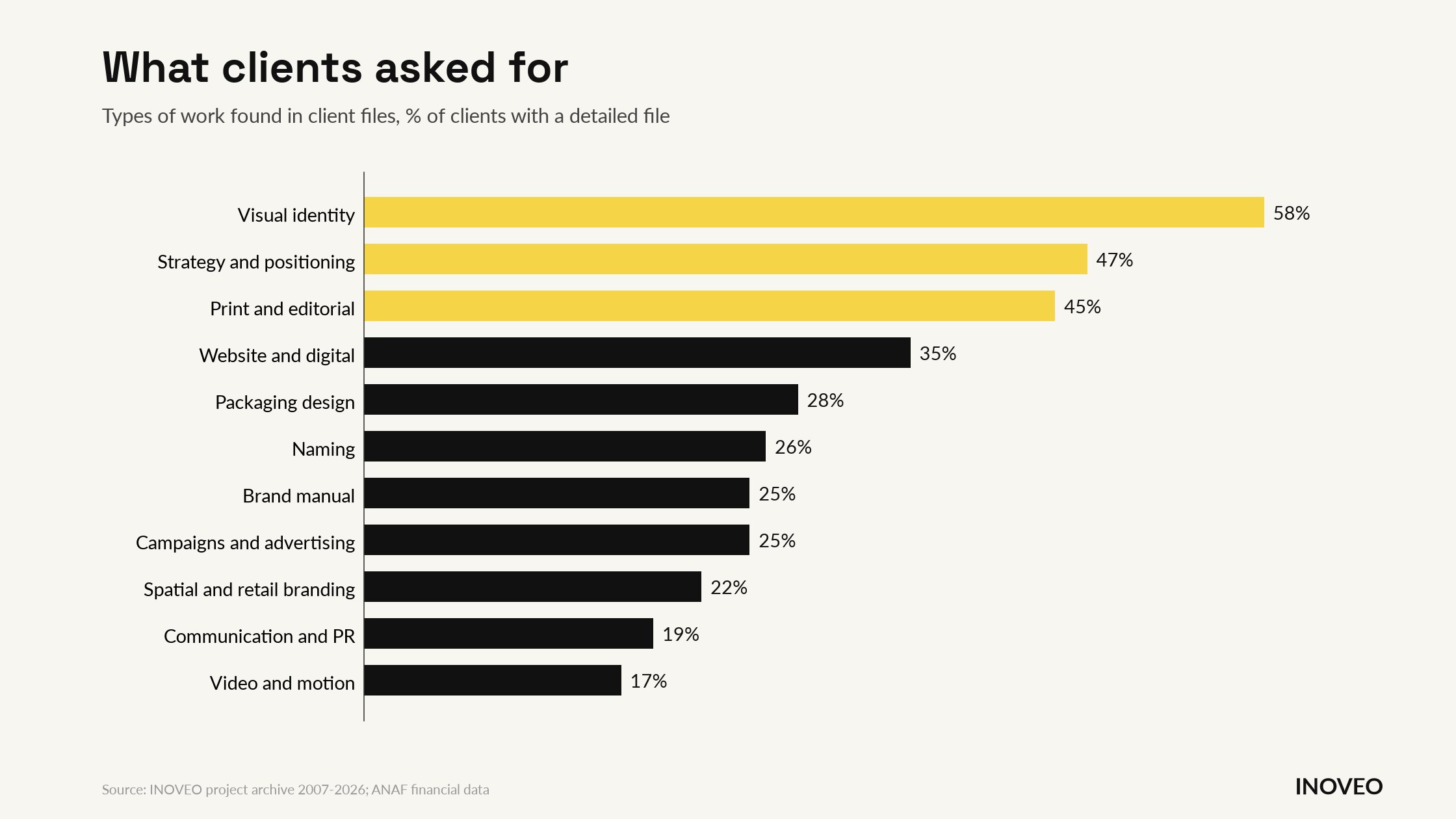
Visual identity leads, as expected. It is the visible part, the one everyone sees, from customer to supplier. The surprise is strategy, requested by 47% of clients. It means that a large share of companies come with a question of direction, even when they phrase it as a design request.
The rarer work on the list can be the largest. At Petrom City, the new headquarters that brought together employees from several Bucharest offices, management chose environmental branding. The brand’s values, pioneering, partnership and professionalism, were translated into space, so that employees live the Petrom brand experience every day.
How many companies ask only for visual identity?
Few. Only 15% of clients with a detailed file asked for visual identity alone.
Source: INOVEO project archive 2007-2026
The rest tied identity to something else: strategy, materials, website, packaging. The difference matters. A visual identity without strategy answers the question “how do we look?”. Strategy answers “why would anyone choose us?”. The first is seen, the second sells.
What do small companies look for in external suppliers?
Public data on branding demand in Romania is missing, so the benchmarks come from the US. A Clutch survey of 517 SME leaders shows that, for 2023, 27% of small businesses were looking for external marketing suppliers and 21% for design. 83% were maintaining or increasing their budget for outsourced services.
Clutch also shows that in 2025, 83% of small businesses have a website, up from 64% in 2018. 45% outsource it and 37% build it in-house.
The American figures show a market where small businesses buy marketing and design as ordinary services, like accounting. For a Romanian company, the practical question is different: which work you buy once, done well, and which work you can then do yourself, following clear rules.
Why do companies change their brand?
Bynder reports that 82% of the marketers surveyed have worked on a rebrand. The stated reasons: 57% wanted an updated identity, 45% a repositioning, 41% a new target audience and 26% wanted to change a negative perception. The survey leaves its date and sample undeclared, so the figures indicate a direction.
Put the reasons next to the requests in the archive and you see the same picture. Visual identity starts the conversation. Repositioning comes right after, almost as often. Companies that do both, in the right order, pay once. Those that start with design and only then discover the question of direction pay twice.
Muzellec and Lambkin (2006), in the European Journal of Marketing, analysed 166 companies that changed their brand. Most often, the rebrand started from a structural change, especially mergers and acquisitions, which touches the company’s identity and strategy. More importantly, the visual change weighed less in brand value than the behaviour of employees. A rebrand holds when the company’s people live it.
What does demand look like, in short?
| Work | Share in the archive | What question it answers |
|---|---|---|
| Visual identity | 58% | How does the customer recognise us? |
| Strategy and positioning | 47% | Why would they choose us? |
| Print and editorial | 45% | What does the customer hold in their hands? |
| Website and digital | 35% | What do they find when they search for us? |
| Packaging design | 28% | What do they see on the shelf? |
| Naming | 26% | What are we called? |
| Brand guidelines | 25% | How do we keep everything consistent? |
| Campaigns and advertising | 25% | How do we reach more people? |
| Spatial and retail branding | 22% | What do they feel in our space? |
| Communication and PR | 19% | What do others say about us? |
| Video and motion | 17% | How do they see us in motion? |
Source: INOVEO project archive 2007-2026
Which important work is often left out?
Brand guidelines, at 25%. It looks like a detail, and in practice it is the piece that decides whether the visual identity stays the same three years from now. Without written rules, every new supplier, every new employee and every print shop interprets the brand in its own way. The result shows on a rack of brochures: five shades of blue, three typefaces, two versions of the symbol.
Likewise, video and PR appear rarely, although they are the channels through which more and more buyers learn about a company before contacting it.
Where does the analysis stop?
- The percentages refer to clients with a detailed file of work. A company can appear under several types of work, so the total exceeds 100%.
- The archive describes demand that reached a single agency. Another agency, with a different profile, would have a different mix.
- The Clutch and Bynder data come from the US or are global; Romania still has little public data on branding demand.
What decision can you make now?
Before you ask for a branding quote, write in three lines what you want to change in the business after the project: more requests for proposal, better prices, a new product launched, a team that explains the company the same way. Then choose the work that serves that result.
If your list contains only visual identity, ask yourself whether you already know, clearly and in writing, why customers choose you. If the answer comes slowly, start with strategy.
Frequently asked questions
What does a complete branding project include?
Usually strategy and positioning, visual identity, brand guidelines and applications: printed materials, website, packaging or space, depending on the type of business. Order matters: strategy comes first.
What is the most requested branding service?
Visual identity, requested by 58% of INOVEO clients with a detailed file. Strategy follows with 47%.
Source: INOVEO project archive 2007-2026
Is it worth doing a visual identity without strategy?
It can be done, and the result can look good. The risk is that the identity tells a story the company has yet to clarify. Only 15% of INOVEO clients with a detailed file asked for visual identity alone.
Source: INOVEO project archive 2007-2026