
Concentration on a few large clients becomes a risk the moment the company depends on them without an alternative. A client that brings in 40% of revenue can take 46% of the company’s value with it when it leaves. And the B2B market pushes towards concentration: purchasing power sits with a few large buyers. Among INOVEO clients, the largest 7% account for 75.5% of the combined 2024 revenue of all clients. The brand is one of the few tools that, over time, bring you new buyers of the same size.
How concentrated is purchasing power in B2B?
We added up the 2024 revenue of all INOVEO clients with public financial statements and looked at how it is distributed. The figures measure the size of the clients, separately from INOVEO’s own revenue. The largest 7% of clients account for 75.5% of the total. The largest 1% alone accounts for 22%. The largest 5% account for 70%, the largest 10% for 81% and the largest 20% for 92%. At the other end, the smallest 50% of clients account for less than 1%.
Source: INOVEO project archive 2007-2026; ANAF financial data
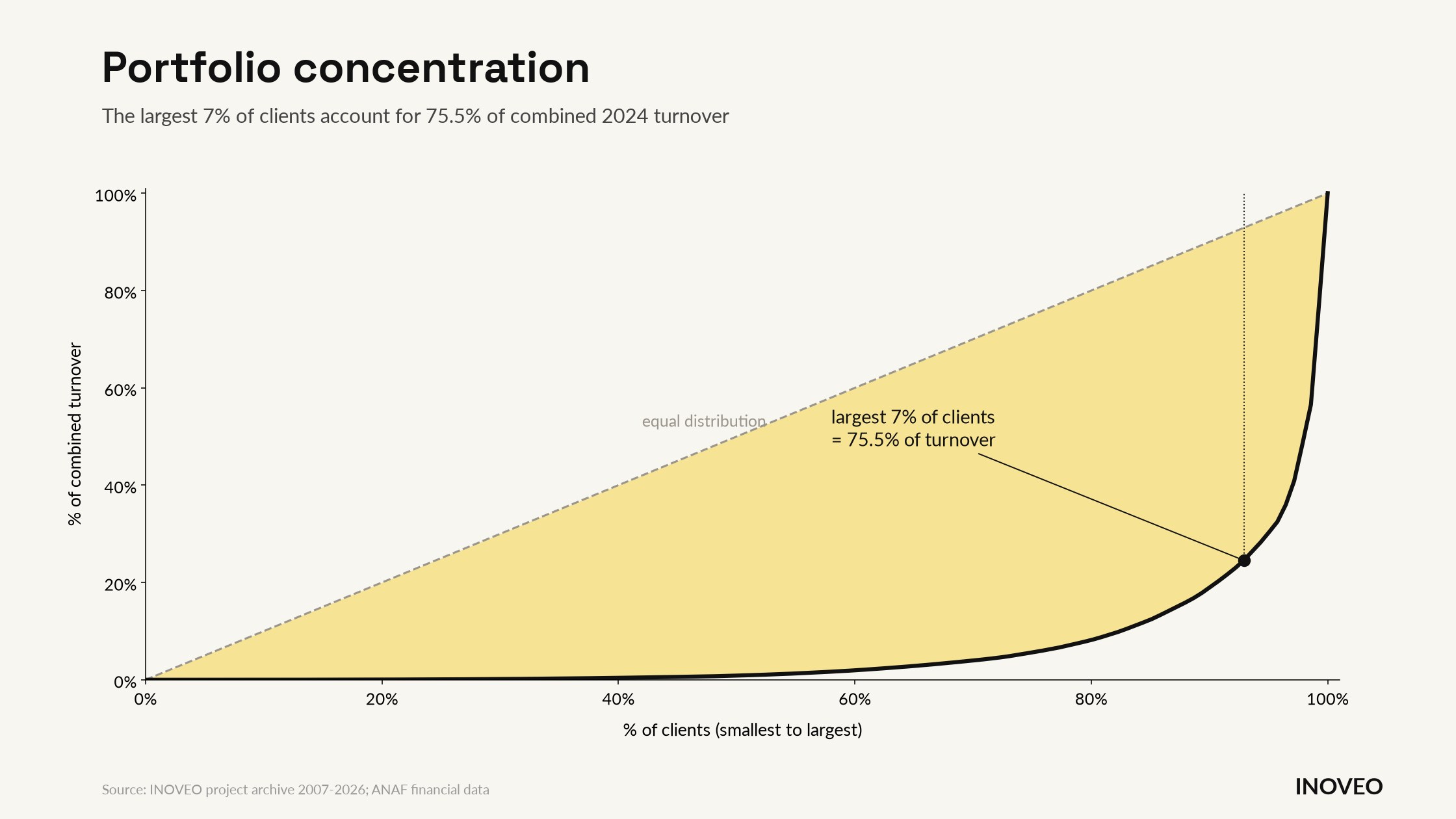
The figures describe the size of the clients, and therefore what any B2B market looks like from a supplier’s point of view: a few very large buyers, many small ones. The Gini coefficient of this distribution is 0.88, a very high concentration. If you sell to other companies, your list of potential clients very likely looks the same. The temptation is natural: you pursue the large buyers, and a few of them end up holding the company.
One way to widen the customer base is a new category. Final Distribution, a company from Prahova known for premium roofing, entered the rainwater systems segment with its own brand, Novatik. INOVEO created the name, the positioning and the visual identity, aligned with the parent company’s platform, and the company thus gained a second route to buyers. See the Novatik project.
What happens to the company’s value when a large client leaves?
Willamette Management Associates modelled a company with 100 million dollars in revenue. If it loses a client that brings in 10% of revenue, enterprise value falls by 11.6%. With a 25% client, the fall is 28.9%. With a 40% client, it falls by 46.2%. The risk premium an investor requires rises by 2.2, 6.8 and 14.3 percentage points respectively (full study, PDF).
Notice how the loss grows: faster than the client’s share. A 40% client takes 46% of the company’s value. For an owner who wants to sell the company or hand it over, this is the first calculation the buyer makes.
Is concentration always bad?
Concentration also has a good side. The Patatoukas study, published in The Accounting Review on 45,442 B2B relationships, shows that the average supplier has 1.8 major customers, each with about 22% of annual sales. Concentrated companies had a return on assets 2.2% higher and a return on equity 4.7% higher, through efficiency: lower selling costs, better planning.
The other side appears in financing. Dhaliwal and colleagues (2016) show that companies with concentrated customers pay more for capital, both equity and debt. The real risk comes from dependence without an alternative.
Does the 80/20 rule apply to customers?
More mildly than you think. Ehrenberg-Bass research shows that over one year, the top 20% of customers bring in on average 59% of a brand’s sales, within a range of 44-68%. Over a quarter, the share falls to about 40%. A 2026 study across 14 US categories found 51% (Libai, Haenlein and Gelper, PDF).
The 80/20 rule is therefore an exaggeration for most brands. The authors note that measurements for B2B are still missing, and concentration may be higher there. For you, the lesson is twofold: large clients matter, and small and occasional clients bring in more than it seems.
What does the risk look like, step by step?
| Largest client’s share of revenue | Fall in company value if it leaves | Additional risk premium |
|---|---|---|
| 10% | −11.6% | +2.2 pp |
| 25% | −28.9% | +6.8 pp |
| 40% | −46.2% | +14.3 pp |
Source: Willamette Management Associates, July 2026
What does the brand have to do with concentration?
A supplier known to a single large buyer lives off its relationship with that buyer. A supplier with a name in the industry also receives requests from companies it meets for the first time. The brand lengthens the list of those who call you first. The longer the list, the less it hurts when a large client leaves.
In practice, this means three things. A positioning that makes you relevant to several industries or types of buyers. Consistent presence where buyers inform themselves: trade fairs, the trade press, LinkedIn, a website with case studies. And materials your current client can pass on to a colleague at another company. Every referral of this kind is a new client brought in by the brand.
Bendixen, Bukasa and Abratt (2004), in Industrial Marketing Management, tested how industrial buyers choose medium-voltage electrical equipment. Price and delivery time weighed more, and the brand accounted for about 16% of the decision. The preferred brand could charge a higher price. For a supplier that depends on a few large clients, this preference means extra negotiating power and more open doors with new clients.
Where does the analysis stop?
- The archive figures describe the economic weight of INOVEO clients, that is, their size. They concern the clients’ revenue, separate from INOVEO’s revenue.
- The Willamette model is a simulation of a standard company; actual values depend on sector and contracts.
- For B2B, research on the 80/20 rule is still incomplete.
What decision can you make now?
Open your sales report for the last 12 months and calculate the share of your largest client and of your top three. If the first exceeds 25%, you have a topic for your next leadership meeting.
Then ask yourself: how many companies in your market would call you if you lost your main client tomorrow? The answer shows how strong your brand is outside your existing relationships.
Frequently asked questions
What does customer concentration mean?
A large share of a company’s revenue coming from a few clients. The risk appears when losing one of them would seriously affect the company and its value.
At what share does a client become a risk?
The threshold depends on the sector. In the Willamette model, a client with 25% of revenue means a 28.9% fall in company value if it leaves.
How do you reduce dependence on a large client?
Through more clients of the same size. The brand helps because it makes you known to future buyers before they need a new supplier.