A brand is worth building from the moment your customer can choose another company. For almost every company, that moment is today. Company size changes the scope of the project and the budget, and the need stays the same at every level. In the INOVEO archive, the companies that commissioned a brand project are spread almost evenly across every revenue band, from under 2 million to over 250 million lei.
What size are the companies that invest in their brand?
The question comes up in almost every conversation with a business owner: “We are still small. Do we build the brand now or wait?” The most honest answer comes from the companies that have already taken the step.
Among INOVEO clients with public financial statements, 23% had 2024 revenue under 2 million lei. Another 21% were between 2 and 10 million, 21% between 10 and 50 million and another 21% between 50 and 250 million. Companies above 250 million lei account for 15%.
Source: INOVEO project archive 2007-2026; ANAF financial data (Romanian tax authority)
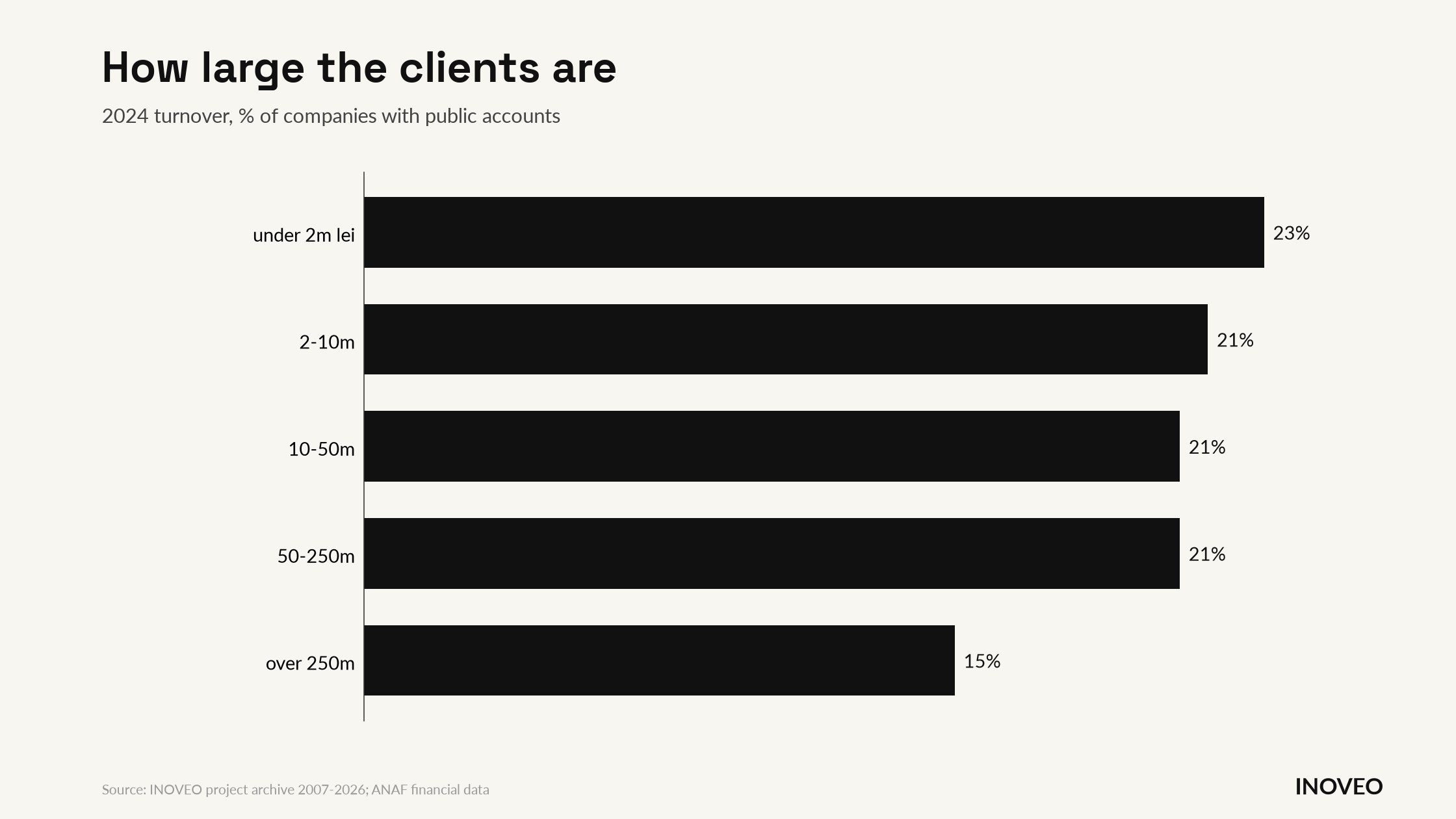
The distribution is almost flat. A company with 1.5 million lei a year and a group with 300 million arrive at the same conversation for different reasons. The small company wants to enter a crowded market and be remembered. The large group has acquired another company and now has two brands telling the same customer different things. The threshold at which the investment pays off depends on the company’s moment more than on the figure in its balance sheet.
An example from the small end of the distribution is Pain au Chocolart, an artisan bakery. The project started from analysis and the brand platform, then continued with the name, the visual identity, the packaging and the website. A neighbourhood business thus received the same working order as a large company, at its own scale.
How large is the SME market in Romania?
Romania’s SME fact sheet, published by the European Commission in 2026, shows that SMEs make up 99.8% of companies, 68.6% of jobs and 57.1% of the economy’s value added (JRC estimates for 2025). Small companies, with 10-49 employees, are 4.3% of the total and provide 19.0% of jobs. Medium-sized companies, with 50-249 employees, are 0.7% of the total and provide 16.9%.
Put the figures side by side and something useful appears. Micro-enterprises are about 95% of companies (calculated from the same data). A company with 15 employees is already in the top 5% by size. Its direct competitors are few, they know each other and the same buyers compare them constantly. There, the way you are perceived decides who receives the request for proposal and who only learns that the contract went to someone else.
Why does size change the budget and leave the need unchanged?
Les Binet and Peter Field analysed the campaigns in the IPA database and arrived at a benchmark that has become a classic: about 60% of effort for brand building and 40% for sales activation. In “Effectiveness in Context”, the ratio was adjusted to 62:38 (IPA). For companies that sell to other companies, the benchmark moves to about 46% brand and 54% activation (LinkedIn B2B Institute). In B2B, too, 46% of the effort works for recognition.
The ratio is about logic, and the amount is about size. A company with 3 million lei works with small budgets, and the same logic asks it to keep a share for being recognised a year from now, even in the months when sales are under pressure. The company that puts its whole budget into discounts and one-off offers buys sales today and stays unknown tomorrow.
In a small company, the brand means three concrete things:
- a clear sentence about what you do and for whom;
- a visual identity used the same way everywhere;
- a website that says the same thing as your salesperson.
All three can be done on modest budgets. Their absence costs more: every offer has to be explained from scratch, and every explanation needs one more meeting, one more email, one more discount.
Research on small firms points the same way. Berthon, Ewing and Napoli (2008), in the Journal of Small Business Management, compared how small and large companies manage their brands and found differences on almost every dimension measured. The second conclusion matters most for you: in SMEs, certain brand practices go together with better company performance.
What changes from one level to the next?
The last two columns are working recommendations, built on the moments when companies usually reach a brand project.
| 2024 revenue | Share in the archive | Typical moment | First work that makes sense |
|---|---|---|---|
| Under 2 m lei | 23% | Market entry, first large clients | Positioning and basic visual identity |
| 2-10 m lei | 21% | First sales team | Shared messages, website, sales materials |
| 10-50 m lei | 21% | Tenders, retail chains, export | Brand strategy and brand guidelines |
| 50-250 m lei | 21% | Several products or brands | Brand architecture |
| Over 250 m lei | 15% | Acquisitions, expansion, succession | Brand system and governance rules |
Source: INOVEO project archive 2007-2026; ANAF financial data
Where does the analysis stop?
- The data includes only clients with public financial statements at ANAF. Foreign and unidentified companies stay outside the bands.
- Revenue is the 2024 figure. Many projects took place years earlier, when the company was smaller.
- The distribution shows who commissioned a brand project. It describes demand. You will find the effect on sales in the article on revenue after a brand project.
What decision can you make now?
Answer three questions honestly:
- Can a new customer say, after the first contact, what makes you different?
- Do your website, your offer and your presentation say the same thing?
- What part of this year’s budget works for recognition a year from now?
If you hesitate on two of them, your company is already the right size for a brand project. Start with positioning: it is the work that makes everything else cheaper.
Frequently asked questions
What budget should an SME put into its brand?
Research offers a ratio rather than a fixed amount. Binet and Field recommend about 60% of marketing effort for brand building and 40% for activation. In B2B, the benchmark is about 46% brand and 54% activation. You set the amount according to the size of the company and how fast you want to grow.
Does a company under 2 million lei need a brand strategy?
It needs a short, clear version: who you sell to, why the customer chooses you and what you promise. 23% of INOVEO clients with public financial statements are in this band.
Source: INOVEO project archive 2007-2026; ANAF financial data
When does the brand become a board topic?
When the company has several brands, enters an acquisition, prepares succession or seeks financing. At that point the brand directly influences the value of the company and becomes part of the leadership’s decisions.