Branding work delivers results when it is done as a system, in the order in which each piece supports the next: strategy first, then identity, then applications. The wrong order costs twice: an identity made before the strategy gets redone when the strategy points in another direction. In the INOVEO archive, 63% of clients with a detailed file asked for at least two types of work, and the most frequent pair is strategy with printed materials.
What work do companies ask for together?
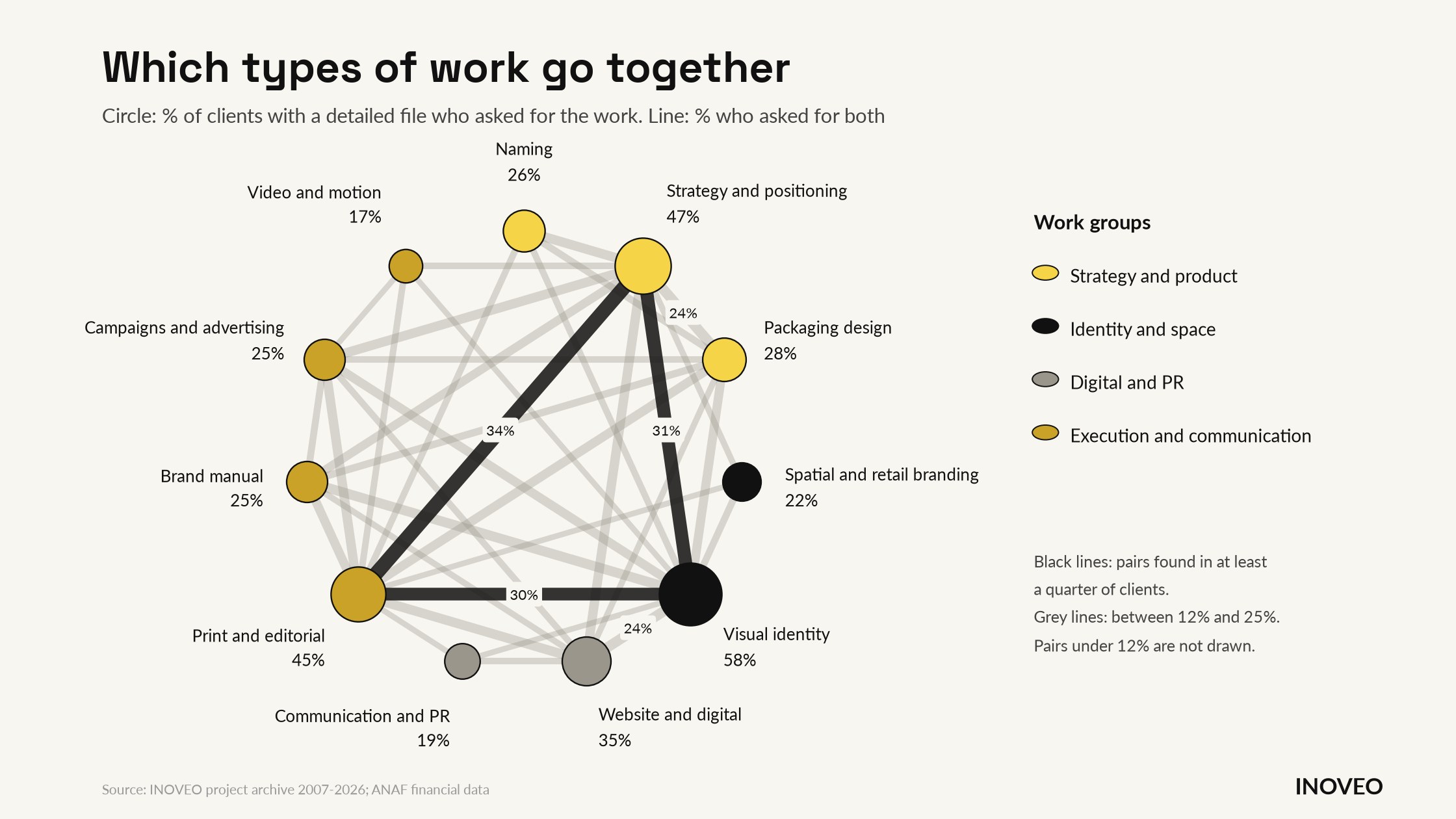
The most frequent pair is strategy and positioning with print and editorial, at 34% of INOVEO clients with a detailed file. Visual identity with strategy follows (31%), then visual identity with print and editorial (30%). Then come strategy with packaging design (24%), visual identity with the website (24%) and visual identity with brand guidelines (23%).
Source: INOVEO project archive 2007-2026
63% of clients asked for at least two types of work, and 47% for at least three. Most companies come for more than one piece. They come for a change, and change needs several pieces that say the same thing.
Source: INOVEO project archive 2007-2026
The order is clearly visible in the rebrand of Poșta Română, the Romanian Post. The project started from the new business strategy, with three pillars, and from a brand workshop with employees from every level and division, then continued with brand architecture, visual identity, brand experience and guidelines. According to the project page, the company’s revenue grew by 3% from 2024 to 2025, based on public ANAF financial statements. See the Poșta Română project.
Which pieces of work depend on each other?
Two figures show the dependencies. 92% of clients who asked for brand guidelines also asked for visual identity. 84% of clients who asked for naming also asked for strategy and positioning.
Source: INOVEO project archive 2007-2026
The logic is clear. Guidelines describe an identity, so the identity comes before them. A name expresses a positioning, so strategy comes before the name. A name chosen without strategy can sound good and still say something other than what the company wants to become. Changed two years later, it costs everything that was printed, registered and learned with it.
On the same basis, the work naturally groups into four families:
| Family of work | What it contains | What role it plays |
|---|---|---|
| Strategy and product | Strategy and positioning, naming, packaging design | Decides what the brand says |
| Identity and space | Visual identity, spatial and retail branding | Decides how the brand looks |
| Execution and communication | Print and editorial, brand guidelines, campaigns, video | Takes the brand to people |
| Digital and PR | Website and digital, communication and PR | Makes the brand found and talked about |
Source: INOVEO project archive 2007-2026
Why do you lose when you do the work separately?
Because every separate piece adds a chance of drift. McKinsey shows that if each step of the customer experience succeeds in 80-90% of cases, only 30-40% of customers have a flawless experience from start to finish.
The calculation is easy to redo. Six pieces, each successful in 95% of cases, together give about 74% (0.95 to the sixth power). In other words, 26% of customers meet at least one piece that says something else. The website made by one agency, the brochure by another, the packaging by a freelance designer and the presentation by the sales team can each be very good. Put together, they can look like four different companies.
Other McKinsey research, on about 27,000 consumers in 14 industries, shows that the experience of the whole journey predicts satisfaction 30% better than touchpoints taken separately. Among banks, those in the top 25% for consistency had 30% higher customer trust than those in the bottom 25%.
Naik and Raman (2003), in the Journal of Marketing Research, measured the synergy effect: when two communication channels work together, their joint effect exceeds the sum of their separate effects. In their data, television and print together had a significantly greater effect than each one alone. Coordinated pieces reinforce one another. Pieces made separately lose exactly this gain.
What order makes sense?
Mastercard is a good example of patient order. According to the official brand history, in 2016 the company simplified its visual identity and adapted it for digital. Only in January 2019, once more than 80% of people spontaneously recognised the two circles without the word “mastercard”, did the company remove the name from the symbol in certain contexts (Mastercard press release).
The radical step came at the end, after recognition had been measured. The lesson for a smaller company is the same: first you build recognition, then you use it. Big changes made early waste the capital built up. For a Romanian company, the logical order looks like this:
- Strategy and positioning: what you say and to whom.
- The name, if a new one is needed.
- Visual identity: how you look.
- Brand guidelines: the rules that keep everything consistent.
- Applications: print, packaging, website, space, campaigns, video.
- Communication and PR: how the story reaches the public.
Where does the analysis stop?
- The pairs show which work the same clients asked for, sometimes in different years.
- The families of work come from a statistical grouping of requests, renamed for clarity.
- The McKinsey studies concern customer experience in general; applying them to brand pieces is an analogy.
What decision can you make now?
List all the brand work you are planning for next year: a new website, a catalogue, packaging, a campaign. Next to each one, put the question: “What strategy does it rest on?” If the answer is “the one in the founder’s head”, start with a written strategy.
Then give all the work to a single person or team responsible for coherence, even if different suppliers carry it out.
Frequently asked questions
What does a branding package include?
Usually strategy and positioning, visual identity, brand guidelines and the company’s main applications. The exact mix depends on the industry and on what the company wants to change.
Can I do the visual identity first and the strategy later?
You can, and the risk is paying twice: the identity gets redone once the strategy points in another direction. The same logic links the name to the strategy: 84% of INOVEO clients with naming also asked for strategy.
Source: INOVEO project archive 2007-2026
Why does it matter that all the work is coordinated?
Because every separate piece adds a chance of drift. Six pieces, each successful in 95% of cases, together give a coherent experience in about 74% of cases.