Brand maintenance means using what you built at launch consistently, year after year, and adjusting it only where the market requires. This is where the most is lost: almost all organisations have brand guidelines, and only about 25% apply them consistently. In the INOVEO archive, 22% of clients came back for brand work in at least two different years, and 78% worked in a single year.
How many companies come back to their brand after the launch?
Among INOVEO clients, 78% worked with the agency in a single year. 22% came back and worked in at least two different years.
Source: INOVEO project archive 2007-2026
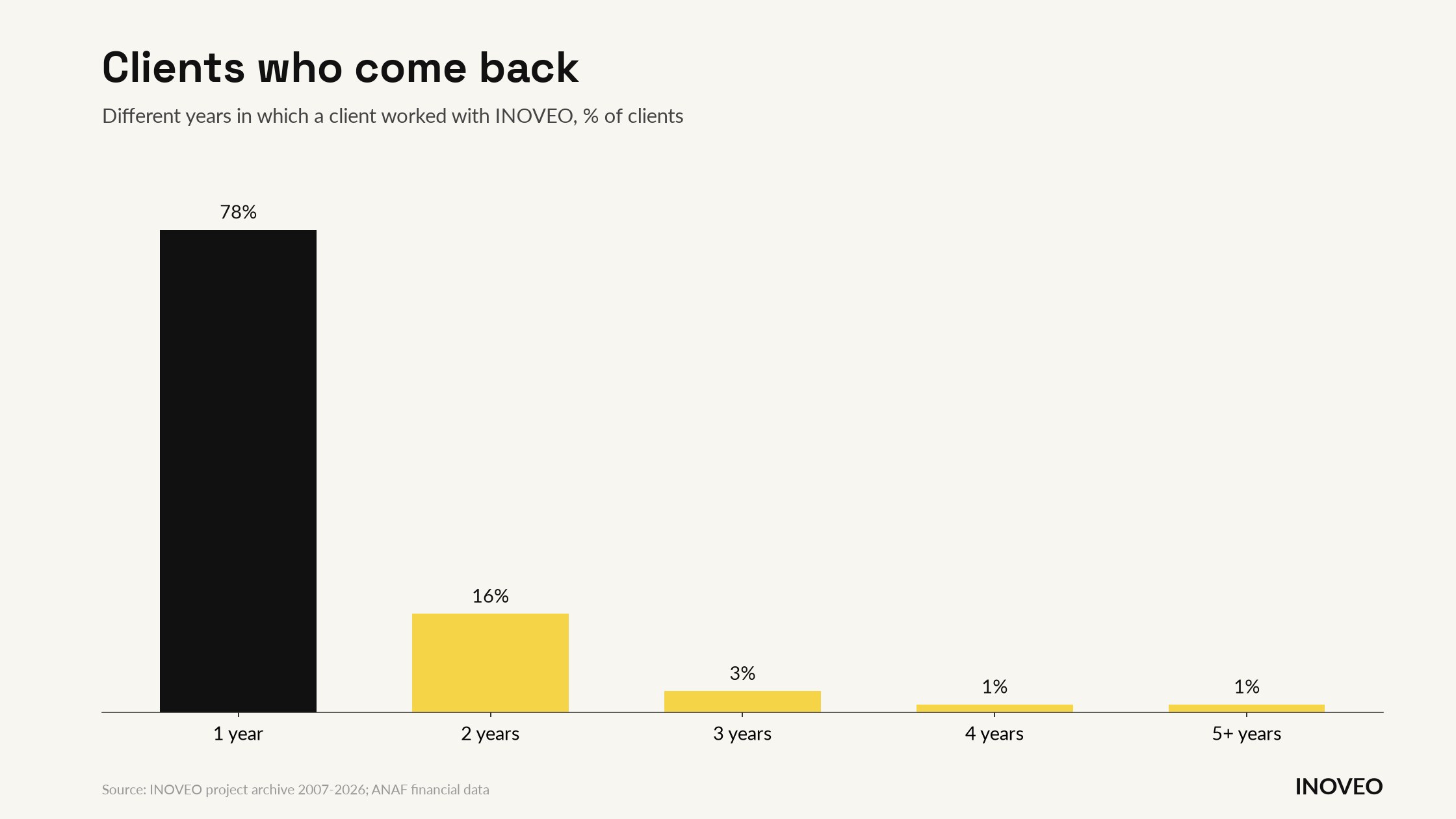
The 22% has a simple explanation. Many companies come back when a new need arises: a new product that needs packaging, a rebuilt website, an expansion that needs new materials, an anniversary. Much more rarely do they come back only to check whether the existing brand is being used correctly.
Teilor, the leader of Romania’s jewellery market, needed rigorous brand guidelines to keep visual communication consistent in stores, outdoor, print and online. The work started from the mantra discovered together in the Brand DNA workshop: bold, authentic, unstoppable. The guidelines became the maintenance tool for every new application. See the Teilor project.
For many companies, the brand feels like a renovation. You do it, you move in, you move on. A brand is more like a garden. It looks excellent on launch day, and in year two grass starts growing between the paving stones: a brochure made by a new supplier, a typeface changed by a colleague in a hurry, a colour that looks different on the website.
Why does a brand wear down after the launch?
Because it gets used. A 2019 Lucidpress study of more than 200 organisations shows that 81% of companies still have materials outside their brand rules (PR Newswire). Between 92% and 94% of organisations have brand guidelines, and only about 25% apply them consistently (MarketSplash analysis).
The gap between “we have guidelines” and “we apply them” is almost 70 percentage points. That is where all the maintenance work lies. The guidelines sit in a folder. The brand lives in the hands of the people who make offers, posts, presentations and print orders.
One clarification: the same Lucidpress study speaks of “up to 33% more revenue” for consistent brands. The figure comes from respondents’ estimates in answer to a hypothetical question, so we set it aside as evidence.
Keller (1999), in California Management Review, describes maintenance as reinforcement work: a brand stays strong through consistency of messages and signs over time, combined with innovation in product and marketing. Frequent changes of direction weaken it, and revitalising a weakened brand usually takes more effort than reinforcing it in time.
What should stay unchanged?
The elements customers already recognise. Ehrenberg-Bass researchers analysed 1,162 brand assets of 128 brands between 2015 and 2023 (International Journal of Advertising, 2026). The average asset is recognised by 26% of buyers and attributed uniquely to the brand by 54% of them. Shapes perform best, with 40% recognition and 71% uniqueness. Colours score only 12% and 39%.
The authors note that consistent use over time strengthens associations. Symbols and packaging usually stay stable, while slogans change often. The practical conclusion: an element recognised by less than 50% of customers needs more use before any replacement. Changed too early, it loses exactly the recognition it had just started to earn.
Why does keeping cost less than winning?
Harvard Business Review notes that a new customer costs 5 to 25 times more than keeping an existing one. Reichheld’s research at Bain shows that a 5% increase in retention can bring between 25% and 95% more profit, in service companies such as banks and insurers.
The same logic applies to the brand. The recognition earned in the years after launch is capital. A brand restarted from zero every three years pays the price of a new customer every time.
What does brand maintenance include?
| Activity | How often | What you check |
|---|---|---|
| Materials audit | Once a year | Offer, website, presentations, packaging, signage |
| Guidelines update | With every new application | Rules for new channels and formats |
| Team training | With every hire and yearly | How the name, tone and visual identity are used |
| Asset check | Every two years | Which elements customers recognise and how well |
| Strategy review | At major changes | New products, new markets, acquisitions, succession |
The table is a working recommendation. For a company of 20 people, all maintenance can fit into one day a year and one person responsible for the brand. For a company with several brands, it becomes a permanent role, with its own budget.
Where does the analysis stop?
- The archive shows the years in which clients worked with INOVEO. Some of them continued maintenance in-house or with other suppliers.
- The 22% includes all clients who worked in at least two different years, regardless of the gap between those years.
- The 25-95% range comes from financial services companies and should be applied with care in other sectors.
What decision can you make now?
Put the last ten materials that left the company on a table: an offer, a presentation, a post, a brochure, an email signature. Lay them side by side and look at them as a customer would.
If they look made by the same company, your brand is healthy. If you see three different companies, you have found the first step: a person responsible for the brand and a yearly check.
Frequently asked questions
What does brand maintenance mean?
Ongoing care so that the brand is used the same way everywhere: checked materials, updated guidelines, a trained team, recognised elements kept and strengthened.
How often should a brand be updated?
The core elements, such as the name and the symbol, change rarely. The guidelines are updated with every new application, and materials are checked yearly.
Who looks after the brand after the launch?
Ideally, a person in the company with the authority to say “this is how we use the brand”, supported by the agency when needed. 22% of INOVEO clients came back for work in at least two different years.
Source: INOVEO project archive 2007-2026