How a teenager from Călărași secretly turned down the Police Academy, took apart everything that moved in her grandfather’s yard, chose Control Engineering, wrote code, and ended up convincing me, twenty years later, that a brand can be a form of love.
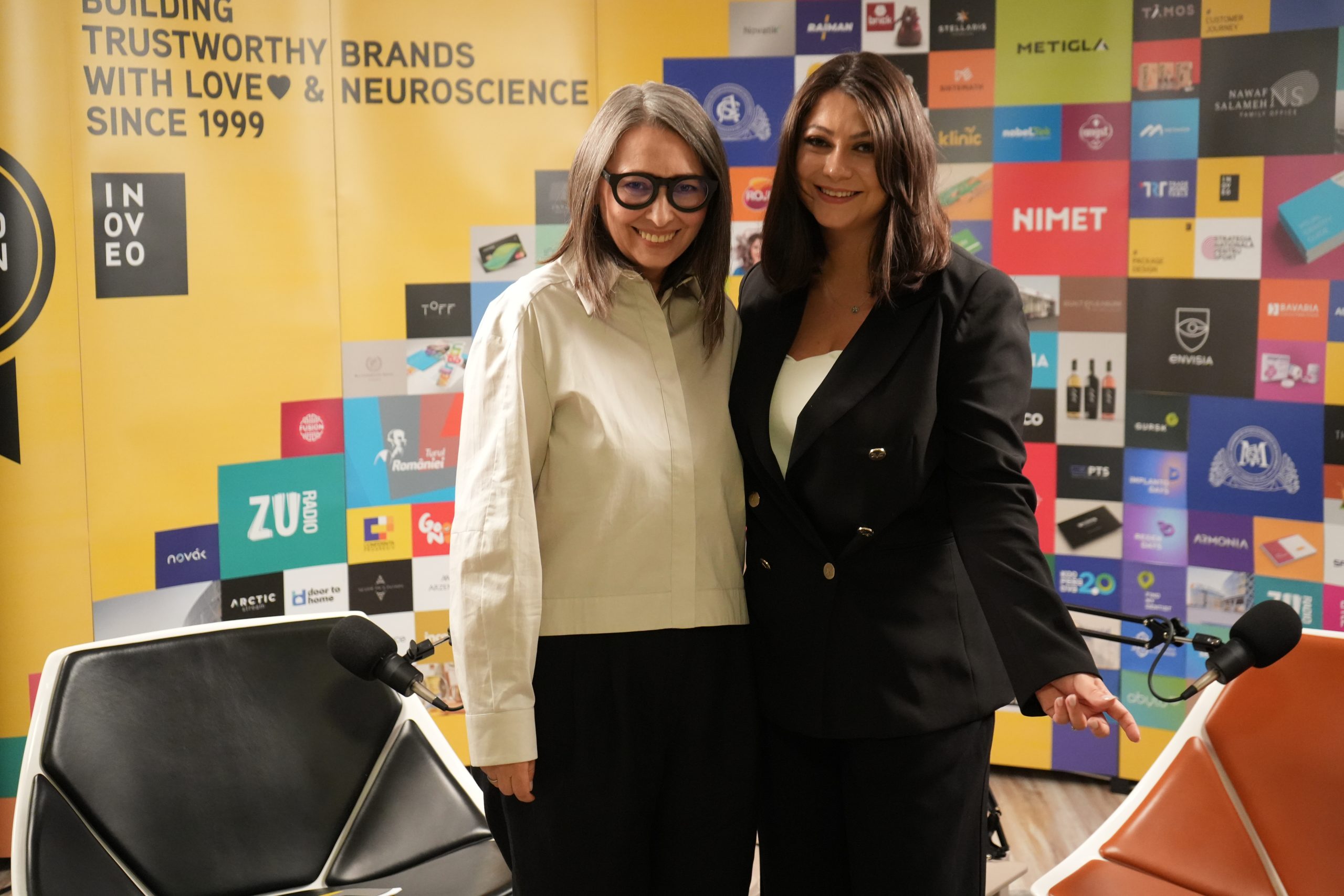
A narrative portrait written by Dochița Zenoveiov, brand strategist and founder of INOVEO, following her conversation with Cristina Rusen, Marketing Director at Gursk, as part of Brand Talks 2.0.
The Summer Kitchen
In a summer kitchen in Călărași, a five-year-old girl sits on her grandfather’s knee. Her grandmother has a hand resting on her shoulder. On the wall hangs an Orthodox calendar. In the corner of the room lies a woven rug, one of those with geometric patterns long vanished from modern homes. Her grandfather is telling a story—one the little girl will lose to time—and you can see on her face that she is listening with that total absorption you only have at five years old, before the world teaches you how to pretend to pay attention.
Someone takes a photograph.
Many years later, Cristina Rusen—Marketing Director at one of Romania’s most reputable dental medical solutions distributors—will flip through a photo album the night before coming to sit down with me for a conversation. She will leaf through hundreds of images and stop at this exact one. She will take it out, slip it into a folder, and bring it with her to the shoot.
“It’s my anchor,” she tells me when I ask her to tell me the story behind the photograph.
And she brings her hand to her neck, where every day she wears a Tree of Life on a delicate chain.
Two Parallel Lives
There are photographs that explain a person at a single glance. This is one of them. The gentle grandmother, the hand that protects. The dynamic, communicative, expressive grandfather—the man who puts on a show. Cristina is right between the two. And what she told me, when I asked her what she had kept from that moment, is that she still relives the scene and the feelings of that day. Her grandmother’s empathy and kindness. Her grandfather’s impulsiveness.
“They show up in my personality every single moment of the day,” she confesses to me.
The Călărași of the 1990s was a small town in the south of the country, near the Danube, with dusty streets and low-slung houses. Cristina grew up there. Her grandparents were also her parents. Her mother wanted something else for her, something more, yet the people who shaped her days were her grandparents in Călărași.
Her grandfather had a workshop behind the summer kitchen.
“He had a different day job, separate from carpentry,” Cristina clarifies, just to be exact. “It was his joy to make something with his hands every single day. A true craftsman.”
And because her grandfather built things, Cristina took them apart. Everything. Every single object in her grandparents’ yard was touched, dismantled, broken, or put back together by her small hands. “Hard to find an object in that yard left untouched by my hands,” she says with a laugh. “Curiosity.”
That word—curiosity—I heard seven times during our two-hour conversation. It is the common thread running through Cristina’s entire life. Later on, when she works in programming, curiosity will pull her out of it. Later on, when she enters marketing, curiosity will keep her there. And later still, when she proposes a complete rebrand to an entire company, curiosity will be the argument that wins the founder over.
But until then, nearly twenty years still lie ahead.
Admissions
Cristina’s mother had a very clear dream for her daughter: a uniform.
The Police Academy. Structure, order, status—a path mapped out from admission all the way to retirement. Cristina had passed the exams. She had been accepted.
During that exact same time, without telling a soul—without breathing a word to her mother, her friends, or her grandparents—she had also applied to the Faculty of Automatic Control and Computer Science. She got in there, too.
She made the choice on her own. She packed her bags, secured a dorm room at the Polytechnic University, and started her new life in Bucharest. Her mother found out two months later.
“At first, it was a shock,” Cristina tells me calmly, in the voice of someone who has repeated that sentence many times and has learned to say it without flinching. “Then we talked. I told her why. She supported me.”
The words sound simple, yet every single word in that sentence hides a world of complexity. At nineteen years old, Cristina Rusen made a decision that many forty-year-olds still put off: to choose her own life against the expectations of someone she loves. And she did it quietly, without drama, simply by physically moving in the direction she wanted to go.
It’s a scene you won’t find written anywhere on her résumé. Yet if you want to understand why, twenty years later, this young woman could look an entrepreneur in the eye and say, “We need to change our brand identity,” without her voice trembling, you have to remember that she had trained that muscle on her own. At nineteen. With her mother.
Black Screens
Polytechnic University, Automatic Control and Computer Science, and then her first job: programming. More specifically, databases and security. Vulnerabilities, servers, black screens with white letters.
Cristina had been working there for a while when something strange started happening. On Saturday nights, while her friends were planning what gifts to buy for a birthday, she was planning what to write to them. Manually. By hand. Thoughtful, beautifully crafted texts. Personalized words. She would place them inside decorated boxes and wrap them with care.
“Everyone was thrilled,” she smiles. “I still have a box at home filled with all those moments, with all those crafted words.”
I should have asked her for that box before BrandTalks. I told her that back then, half-joking, though I meant every word: that box was a narrative gem I missed out on.
There comes a moment in the life of everyone who changes careers in their thirties when you realize that what you do for joy and what you do for a paycheck are two completely different things. For Cristina, that moment arrived on an ordinary day at the office, sitting in front of a black screen. “I was doing something that, well, worked. It was fine. Just devoid of challenge.”
She gave herself three months. Three months to test out marketing. An experiment. If she liked it, she would make the switch. If not, she’d go back to code.
Many years have passed since then. And she stayed in marketing.
Hand-Poured Glass
Cristina’s first job in marketing, back in 2007, was at a company in Bucharest that manufactured handmade glass objects. Vases, glasses, decorative pieces—all hand-poured in the workshop, one by one, by artisans who worked with hands burned by fire.
“I used to go down into the workshops and watch,” she tells me. “How every single object was made.”
It’s an important image, one I want you to hold on to. A twenty-something woman with a degree in Automatic Control and Computer Science who, instead of sitting behind a desk, walks into a workshop to watch a craftsman blow glass. That same old curiosity from her grandparents’ yard in Călărași—only bigger now, more channeled. Cristina was beginning to realize she could actually make a living out of this.
She did a bit of everything. Social media, product communications, the website. “Around 2007. I was also coding—I knew how to make their website actually function.”
She calls it an intersection.
“I found an intersection between who I was in terms of my technical background and the creativity I rediscovered along the way.”
That’s the second observation from our conversation that stuck with me: people who pull off truly successful career pivots rarely abandon what they knew before. They combine it. Cristina stepped into marketing with programming in her back pocket and turned it into a competitive edge.
The Phone Call
How did she end up at Gursk? Through a phone call.
A friend—an old friend who had worked in the dental industry—used to tell her every time they met about the people, the clinics, and that parallel universe doctors build around their patients. Cristina listened. Curiosity was already quietly at work inside her.
When the job opening at Gursk Medica appeared, he was the very first person she called. “What’s the company like? Is it worth applying? Would you go back there?”
“Go for it—you’re going to love it,” he told her.
She applied.
At the interview, before even meeting the people, she walked through the door and saw the light. The plants. The colors. “It felt alive in there. Warm and welcoming.”
Then she met Arhip PoGurskki, the founder.
Arhip
There are entrepreneurs who build their companies like armies. There are entrepreneurs who build them like design projects. Arhip PoGurskki, by Cristina’s account, builds his like a family. I felt that myself when I met them later on, during our rebranding project.
“I realized from the very first moments the way he builds this business,” Cristina says. “The way he relates to people—both inside the company and outside of it.”
And then she adds a line that a Romanian marketing director rarely utters about their boss, simply because it risks sounding insincere:
“It was love at first sight.”
Only in her case, it rings completely true. Because three and a half years after that moment, when you ask her what keeps her there, she tells you the exact same things she felt in her first ten minutes through the door. Values. Roots. The way the founder passes something meaningful down to every member of the team.
Inside this company, there is a board. A board in the office kitchen, covered in drawings and messages that are only ever added to, never erased. Everyone who joins Gursk leaves their mark on that board. Cristina shows it to every single new hire. “It was one of the reasons some of them chose us.”
It’s a small detail, yet if you want to understand what “company culture” actually means, it starts with a board in a kitchen that nobody ever wipes clean.
The Email of May 15, 2024
On May 15, 2024, around… let’s say sometime in the afternoon, Cristina Rusen was writing an email. She was writing it carefully. It was her very first contact with a branding agency, and she wanted it to sound right.
That email landed in my inbox. I still have it on my phone; I reread it right before inviting her onto the podcast. Here is what it said:
“My name is Cristina Rusen, Marketing Manager at Gursk. At this moment, we are facing a lack of a clear brand identity and would like to initiate a project to create a comprehensive brand book that reflects our company’s values and vision.”
The attachments: a company profile. A brand book brief. Detail upon detail.
If you’ve ever wondered what an email that changes the course of a business sounds like, this is it. Concise, exact, well-researched. Homework done and written neatly on the board. I knew from the very first read that I was looking at a future partner who knew precisely what to ask for. It was a clear sign I’d be working with someone who had done her homework.
Before that email, however, there had been invisible groundwork. Two-plus years since Cristina had joined Gursk. Two-plus years of studying the industry, the partners, the clients, the suppliers. “It was a period of discovery, an unfamiliar field for me. I was stepping onto entirely new ground.”
Then the moment arrived. Cristina describes it as a sudden realization, though it had clearly been maturing inside her for months: “I realized we needed a rebrand the moment I realized the company had reached a whole new level.”
She put together a presentation. “I’m the kind of person who does her homework thoroughly, and it’s always backed up by a presentation.” She went to Arhip and Dana, Arhip’s wife and co-founder. She presented.
“Thankfully, I’m a marketer who gets listened to,” Cristina says with a faint smile. “It didn’t take much convincing. It was an instant click.”
The word “click” matters here. Because if you look closely, you’ll see that in Cristina’s professional life, everything happened through clicks. The click to leave coding behind. The click to apply to Gursk. The click to propose the rebrand. This woman operates intuitively on top of a very thick layer of research. A rare combination—one that, in more than twenty years of brand strategy, I have encountered only a handful of times. Though lately, more and more often.
Two Days of Workshop
The two-day workshop was the moment when the Gursk Medica team and our team at INOVEO truly got to know one another.
On day one, debates. Tension. Ad-hoc teams clinging to their prompt cards with the fierce competitiveness of seasoned salespeople. “You locked into small teams and came out swinging,” I told Cristina later. “Until you realized it was actually about the future of Gursk, and that you all needed to pull in the same direction.”
Cristina confirms: “We’re very competitive.”
The animal exercise—the present animal, the future animal. The architecture exercise. Colors. Shapes. Each team defending its choices.
Then the real breakthrough arrived on day two, near the end. An exercise I improvised on the spot when I felt the energy shift in the room: a timeline of defining moments. Everyone in the company was asked to place their most meaningful moments at Gursk onto a timeline. Small scenes. Expressions of gratitude. Things kept strictly to themselves until that afternoon.
People started crying. Genuine tears. And they thanked one another.
What surfaced were stories of how Arhip had stood by team members during moments of personal hardship—quiet acts of support kept private until that very day. Small, repeated, unexpected gestures.
“It was a reaffirmation for every member of the team that we are more than just a team—we are people living out shared values,” Cristina says.
In that moment, I grasped the true depth of a single word: family.
Business books love to warn that this is a dangerous word for a company. “Team,” they argue, is healthier, more professional, better bounded. I shared that perspective with the Gursk team; I even showed them what modern business literature says about family versus team (No Rules Rules).
Nothing changed. They held their ground. They remained a family.
“Because the emotion here runs far deeper,” I told them.
Alex, Mari, and the Field of Poppies
In the first photograph Cristina brought to the interview, she was five years old, sitting in the summer kitchen in Călărași.
In the second, there are three people standing in a field of poppies.
They’re on their way to Poiana Brașov, sometime in late May or early June. The Gursk Medica marketing team is heading to Implanto Days, the largest annual dental event the company organizes. They’re tense. There’s work to be done. Yet before arriving, they pull the car over. A red field, carpeted in poppies, beneath a sky almost too blue to be real.
In that field, Cristina, Alex, and Mari take a photograph.
“They’re the two designers who took on this entire brand book,” she says as she lays the photo on the table.
Alex and Mari are the people with whom Cristina has lived through, in her own words, most of her defining moments. The ones who know her best. The ones who have seen her from every angle—both the sides she wanted to show and the ones she would have preferred to keep hidden.
When the brand book arrived from INOVEO, the first thing Alex and Mari had to do was apply it. Which meant looking straight at their own ingrained design reflexes and rewriting them. “It was a challenge. They had to adapt every asset to match the new look we had agreed on. It took a while—the transition period wasn’t easy for them.”
Was it easy or hard to work with a brand book? They suggested talking it over—maybe tweaking a few things in the manual. Cristina stopped them. Politely, firmly, briefly.
“Let’s try doing it step by step, exactly as it’s laid out in the manual. And we’ll see as we go.” Today, she has moved past that strictness. “I’ve become more flexible since then,” she smiles. “But at the very beginning, it mattered that we executed things to the letter.”
The discipline that saved the brand. The very same discipline that the five-year-old girl had learned in her grandfather’s workshop: that things are taken apart and put back together methodically.
St. Nicholas Day
In early December 2024, I walked into the Gursk Medica headquarters carrying a physical object. A brand book. Printed, thick, hardcover. We had spent months building it. I wanted to hand it to Cristina myself, in front of the entire team. Like a trophy.
Cristina was expecting a digital delivery. She knew it was coming—it was written into the contract—but she had pictured a PDF. Slides. Google Drive folders, the way she usually works.
And yet, when I handed it to her, something shifted. Cristina’s voice took on inflections I had never heard from her before. The words caught in her throat. She stood there holding the book in her hands, completely silent.
“It was the most beautiful gift I have ever received,” she would tell me a year later, on the podcast.
Arhip’s speech followed. He, too, was visibly moved. He spoke about how hard the company had worked to reach that moment—about how the manual represented far more than a visual identity; it was a mirror of the people who had built Gursk.
Cristina listened as a single tear slipped down her cheek.
“It was also a realization,” she explains, “of all the things that were about to come to life visually. That moment was both the end of a project and a beginning. The beginning of everything that was about to be seen.”
This is the third takeaway I want to leave you with from Cristina’s story: the biggest moments in a marketer’s professional life usually look entirely unremarkable from the outside. Someone is handed a book. They cry. And that’s it.
Yet right there, in that quiet instant, the way an entire company communicates with the world for the next five, ten, or twenty years changes forever.
Iași
One week before sitting across from me on the podcast, Cristina was in Iași. A medical trade show. Hundreds of booths, hundreds of brands, hundreds of people dressed to the nines pitching their products.
A Gursk Medica partner—a doctor, whom she would later learn was an implantologist—walked up to their booth. Cristina greeted him. They chatted for a few minutes about products, programs, and what was new at the company.
At one point, the man paused. He looked at the booth. At the logo. At the chosen colors. At the typography. At the printed materials.
And he said to her:
“You’re the only ones who got the colors, the font, everything right. To be human. That’s what represents you.”
Inside, Cristina went quiet. Because nothing she had said to that man over the previous ten minutes had mentioned brand values. Or the word “human.” Or positioning strategy. Or a two-day workshop. Or a thick hardcover manual delivered right before St. Nicholas Day.
The man had read the whole story on his own. From the colors. From the typeface. From the way the booth was put together.
“And if I had to start all over from scratch, I’d do the exact same thing,” Cristina tells me on the podcast.
That is the moment you understand why an entire team listens to her. Why the founders said yes without asking a second question. Why, when I first read her email on May 15, 2024, I knew this project would succeed. Cristina Rusen sells something far beyond marketing. She sells trust wrapped in sticky notes, in color-coded partner spreadsheets, in presentations researched down to the last comma, in emails written on May 15, 2024, that show precisely where she intends to go.
She sells that childhood in Călărași.
She sells the curiosity of the little girl who took things apart just to see how they worked.
She sells the quiet grit of a nineteen-year-old who made a choice on her own against her mother’s wishes—and learned that good decisions are made with thorough preparation, yet carried through to the end without flinching.
The Confession
Near the end of the podcast, I asked Cristina if there was anything she had kept to herself throughout the rebranding process. One final little secret.
She hesitated for a second. Then she told me:
“I was afraid.”
She reached up again to touch the Tree of Life at her neck—that familiar gesture she makes whenever she needs to ground herself.
“I was afraid at every single step. About how it would turn out in the end. Because I was going through this for the very first time. I put a huge amount of pressure on you to guide us, to tell us what steps to take. And I carried a real fear that maybe I wouldn’t be ready to support you properly.”
That is what stays with me. The image of a woman who orchestrated a complete rebrand, who convinced an entrepreneur in ten minutes, who held a team together through two days of an emotional workshop, who enforced brand-book discipline on seasoned designers, who earned praise from partners in Iași—and who, the entire time, carried a fear she refused to let show.
She got past that fear, she tells me, the moment she saw the project plan. The calendar. The checklists. The tables mapping out who, what, and when. “The organization. That’s when I said: This is right. We’re going to be okay.”
And right here, the circle closes. Because if you look closely, you see a Cristina Rusen who conquers fear through method. That’s how she turned down the Police Academy. That’s how she transitioned from programming into marketing. That’s how she convinced Gursk to rebrand. That’s how she received the brand book. Fear doesn’t paralyze her. It simply makes her do her homework even better.
I, in turn, learned something from that. In twenty-five years of brand strategy, I have met very few partners who turn fear into a working tool. Cristina is one of them.
Coda: The Tree of Life
There is one last small detail Cristina mentions almost in passing, and it stays with me. Her grandmother is a woman of faith. In the summer kitchen in Călărași, hanging on the wall, there was an Orthodox calendar. An old icon. Thirty years later, the kitchen has been renovated. Many things have changed.
“Yet that calendar, that old icon, is still there.”
It’s a line that tells you everything about this person. Cristina Rusen turned down the Police Academy. She changed careers. She changed cities. She moved across three or four companies. She led a rebrand. She instilled discipline across an entire team.
Yet the Tree of Life around her neck is the exact same one from her childhood.
And the calendar on her grandmother’s wall is still right there.
Because strong people are the ones who hold on to their roots even as they reinvent themselves. They carry them wherever they go and use them as an anchor whenever they need to do, once again, something entirely uncharted.
Like writing an email on May 15, 2024, to a branding agency you barely know.
Like receiving a thick hardcover book in December and crying.
Like standing at a trade show booth in Iași and hearing a complete stranger say out loud the exact thing you had secretly wanted to say about your company all along.
“And if I had to start all over from scratch, I’d do the exact same thing.”