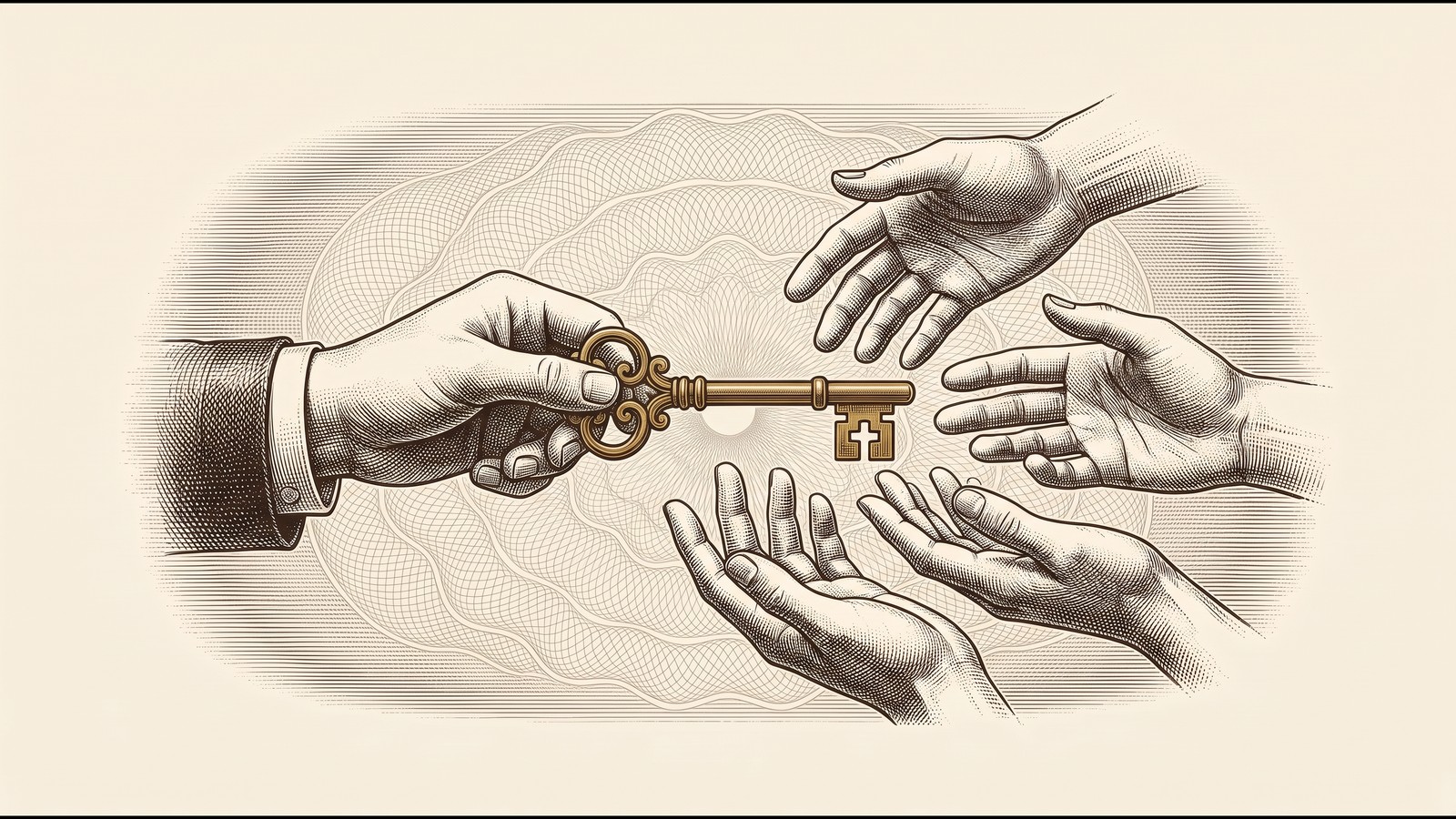
Moving a brand from founder to company means writing down what the founder knows by instinct: the promise, the tone and the criteria behind every yes or stop. In the INOVEO archive, companies were a median 11 years old at their first project. At that age, the brand has to work when the founder is out of the room.
Source: INOVEO project archive 2007-2026
What does a company gain when the brand moves from founder to company?
It gains the meetings the founder misses. And for you, as for everyone, those are the majority.
Gartner measured how B2B buyers split their time: they spend only 17% of their buying time with suppliers, all suppliers combined. The other 83% has moved to websites, documents, internal discussions and referrals. Your founder is absent there. The brand does the talking.
The 6sense data shows you what happens next. In 95% of cases, buyers choose a vendor from their day-one shortlist. The list was already made before your first phone call.
The causal thread is short. The decision formed while the founder was absent. So the brand has to say what the founder would say, in the same words. When it does, your company makes the list. The business consequence: every salesperson, page and proposal carries the same idea.
For you, as the founder, the gain is just as concrete. You get your time back. You can work on direction and on the product. The brand you built moves forward through people you chose yourself.
What does the INOVEO archive show about company age at the first project?
The fact, first. Of the 232 INOVEO clients between 2007 and 2026, we could establish company age at the first project for 172. The median is 11 years. Some 47.1% were under 10 years old.
| Company age at first project | Number of companies |
|---|---|
| 0-4 years | 45 |
| 5-9 years | 36 |
| 10-19 years | 46 |
| 20 years and over | 45 |
Source: INOVEO project archive 2007-2026
The interpretation, separately, so you can weigh it yourself. The distribution splits almost evenly across the four bands. That tells us the brand question came up at every age. Companies aged 10-19 and those over 20, however, add up to 91. These are companies where the founder has already built a strong personal reputation, often across a whole industry. That’s exactly where the need for a transfer appears: the brand exists, it lives through people, and the company wants to use it at scale.
Company size leads us to the same reading. In 2024, the median headcount across 141 clients was 18 people. Together, all the clients analysed employed 46,897 people.
Source: INOVEO project archive 2007-2026
At 18 people, the founder still knows everyone. It’s hard to believe, though, that they can sit beside every proposal and every post. A written brand takes over that work. It frees you from it.
Why does moving the brand into the company work?
It works because it turns one person’s judgement into criteria that many people can apply.
You, as the founder, decide quickly what fits the company. You know which client to accept and which project to decline politely. That judgement is tacit. It formed over years of experience and it sits in your memory.
A good transfer makes it explicit, in three moves:
- The judgement is written into a list of criteria. For example: “we state the price up front” or “we speak in figures, with few adjectives”.
- The criteria repeat identically across 18, 50 or 500 people.
- Repetition produces a consistent message for the client, and consistency produces trust.
Trust is what gets onto the day-one shortlist. That’s how the mechanism connects to the 6sense figure, and you see the effect in leads that arrive already warm.
There’s one more, quieter effect: the team decides on its own more often. You get fewer “is this OK?” questions. You get decisions already made, which you confirm in a minute.
What are the 4 steps of the transfer?
The steps come from the types of work found in our client files. The order matters.
Step 1. The inventory. You listen to the founder, then the team, then a few clients. You note what the founder has been saying for years and the stories repeated at every meeting. You also note what clients have told you. The gap between the two lists shows you what has already been passed on and what has stayed in the founder’s head.
Step 2. The written strategy. This is where positioning, promise and decision values are fixed. The strategy is the document that replaces the phrase “ask the boss”. It comes before identity, because identity needs an idea to show.
Step 3. The brand manual. The strategy becomes visual and verbal rules, with examples. The manual shows you how the promise applies to a proposal or to a delivery truck. We explained its structure in the guide on what a brand manual contains.
Step 4. People and roles. Someone in your company becomes the brand owner. In larger companies this role often sits on the board. We described the model in the article on the brand advisor on the board. The founder stays the main voice. Now there’s a team beside them speaking in the same register.
What types of companies have taken this step?
Our clients’ names stay protected. The types of companies are clear in the archive, though.
By NACE section, most come from manufacturing (40) and trade (38). Next come professional services (22), IT&C and media (17), finance (10) and construction (8). In our sector register we find retail and fashion (13), real estate (12), healthcare (12) and FMCG (12).
Source: INOVEO project archive 2007-2026
In the 96 detailed client files, strategy and positioning appear for 45 clients. The brand manual appears for 24. The median is 2 types of work per client, which tells us companies build step by step.
Source: INOVEO project archive 2007-2026
The fact that tells us most about the transfer is duration. A total of 51 clients, or 22%, worked with INOVEO in at least 2 different years. Among those who return, the relationship lasts a median of 3 years. The longest relationship spans 15 years.
Source: INOVEO project archive 2007-2026
Our interpretation: the transfer happens in stages. Strategy first, then identity, then application across the team. Family businesses and founder-led companies came back to us, we believe, once the company had grown and the brand had to be carried further. You can see examples of the work in the INOVEO portfolio.
Where does a brand transfer stop?
We’ll tell you the limits openly. We found them in our own data.
The archive shows us company age, size and types of work. The effect of the transfer on sales sits outside the data. Measuring it would need a control group, and what we have is a descriptive comparison.
The growth data calls for caution. Between 2019 and 2024, across 125 clients, median annual revenue growth was 10.5%. Romania’s nominal GDP grew 10.8% a year, according to INS, the national statistics institute. The honest interpretation: clients grew at the pace of the economy.
Source: INOVEO project archive 2007-2026
So a brand transfer makes your work lighter and your message consistent. Growth remains the result of the product, the team and the market.
The second limit is about people. A document changes little if the team leaves it in a drawer. The transfer takes time and a person to defend it. In a small company, that person is often still the founder, in a new role: mentor of the brand.
The third limit concerns the personal voice. Some companies live on the founder’s charisma. Clients come for that person, and that’s natural. There, the transfer keeps the founder in the foreground and builds a team around them that carries the style forward.
How do you decide whether it’s the right moment for your company?
Answer three questions, with your team in the room:
- Can a new colleague explain in two sentences what the company promises, the way the founder would?
- Do the proposals, the website and the presentations look like they come from the same company?
- How many communication decisions land on the founder’s desk each week?
If the answers vary a lot from person to person, the transfer is useful now. If they already line up, an updated manual may be enough.
For a wider view, read the analysis of what happened to clients after brand strategy.
And one question for you to answer among yourselves: what does your founder know that still exists only in their memory?
Frequently asked questions
What is a founder-to-company brand transfer?
It’s the process that moves the founder’s promise, tone and criteria into documents and rules the whole team applies, so the brand works the same way in every client conversation.
At what company age does it usually happen?
In the INOVEO archive, the median company age at the first project is 11 years. Companies come at every age, though: 45 were 0-4 years old and 45 were over 20.
Source: INOVEO project archive 2007-2026
How long does a brand transfer take?
The strategy and the manual are a project of a few months. Team adoption takes longer. Among INOVEO clients who return, the relationship lasts a median of 3 years.
Source: INOVEO project archive 2007-2026
Does the founder remain the voice of the brand after the transfer?
Yes. The founder stays the main voice and ambassador of the company. The transfer gives them a team that speaks in the same register for the moments when they’re absent.
Does revenue grow after the transfer?
Our data shows clients grew at the pace of the economy: a median 10.5% a year, against 10.8% nominal GDP. The comparison is descriptive, with no control group.
Source: INOVEO project archive 2007-2026