Good FMCG packaging keeps the cues shoppers use to find your product in a few seconds and changes the rest with method. Tropicana lost 20% of Pure Premium sales in 7 weeks after its new carton in 2009. For you, the order becomes simple: learn what customers recognise, then redesign.
What does new packaging mean for your sales?
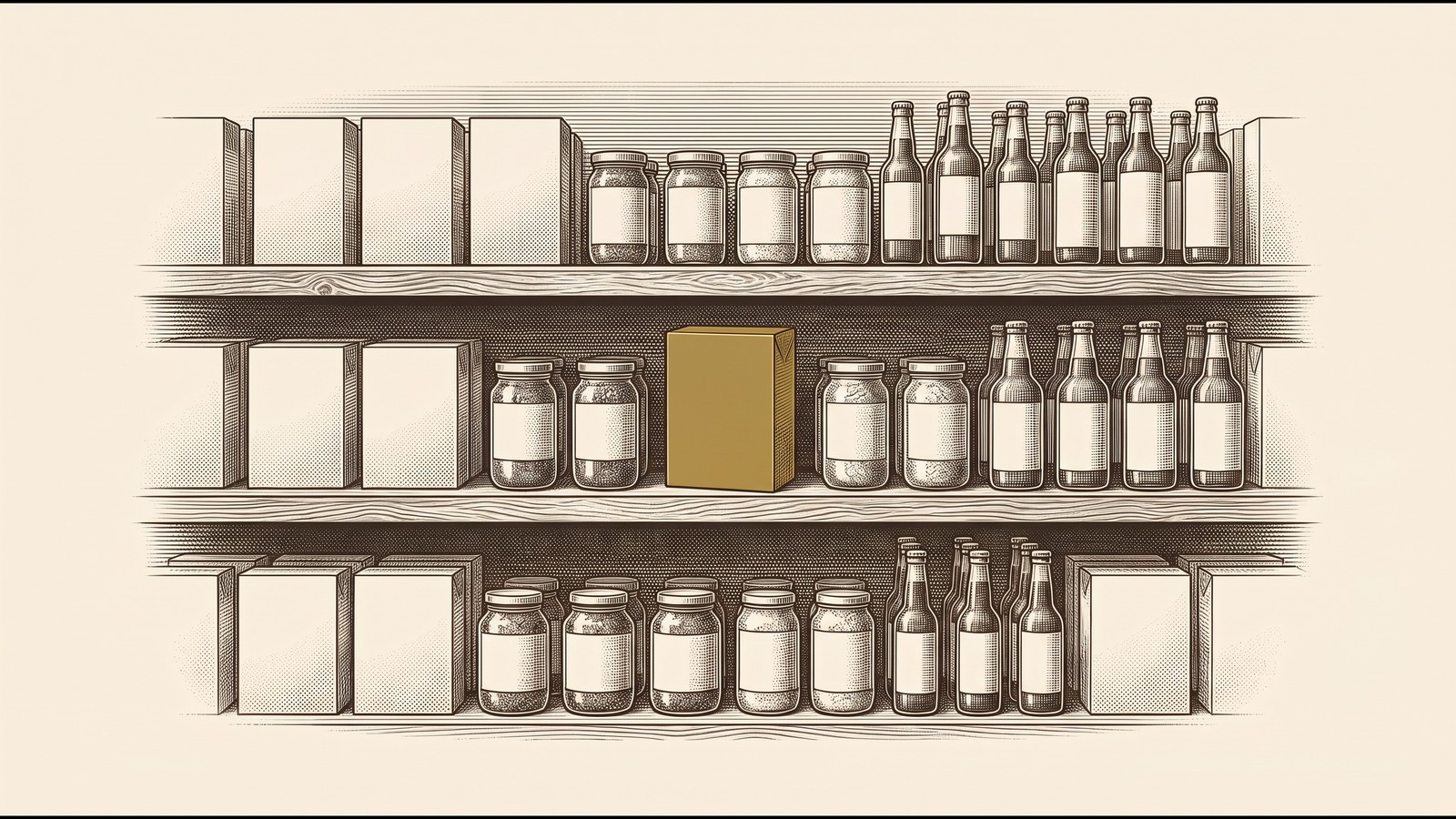
The shelf is where your brand has the least time. Your shopper arrives with a short list in mind. They look for you by a colour, a shape, a cue they have known for years, from a thousand quick shopping trips. When they find you, the product goes into the basket. When they meet something unfamiliar, the hand moves to the neighbour on the shelf.
The consequence is direct. You feel it in sales. Your packaging works as a silent salesperson in every store where you are listed, every day of the year. A redesign changes the way your salesperson talks to thousands of people at once.
Changed well, packaging gives you clarity and room for a new message. Changed in a hurry, it erases exactly the cues your loyal customers rely on. They choose you out of habit. They bring the steady volume that pays for listings in retail chains.
That is why the first step of an FMCG packaging project is a recognition inventory. You learn what people see today when they look for you and your product. The pencil comes after. Always after.
What happened to Tropicana in 2009?
Facts first. They are public.
The redesigned Pure Premium carton reached shelves in January 2009. Between 1 January and 22 February 2009, the line’s sales fell 20%, by the Advertising Age count cited by Empact Partners. A later study of grocery-store data estimated the cost at about 27 million dollars. The authors state clearly that it is a modelled figure, for a single sales channel.
Now our interpretation, kept apart from the facts.
Shoppers knew the old carton at a glance, and the new carton, clean and modern as it was and faithful to every rule of graphic good taste, mattered less to them than the familiar image they had grown used to over years of shopping. For the hurried person in front of the shelf, the known product slipped out of sight, even though it stood in the same place. The drop looks tied to lost recognition more than to the graphic quality of the new design.
The lesson? We will put it simply. Packaging has two jobs at the same time: to be found by those who look for it and to be noticed by those who see it for the first time. Tropicana won the second job and paid on the first. For us, this case is a reference point in every packaging project: the question comes before the sketch.
Why does the shopper look for shape before text?
The mechanism lies in how we decide at the shelf. You do the same when you shop. You save effort. You read little and recognise a lot. Your eye catches the dominant colour first, then the shape, then the position of the logo. Text comes last. Sometimes it never comes.
The causal thread looks like this:
- A distinct cue, repeated for years, enters the shopper’s memory.
- At the shelf, that cue shortens the search to a second or two.
- A short search makes the choice easy.
- An easy choice repeats, and repetition builds volume.
Kantar research points the same way. Brands perceived as “meaningfully different” have 5 times higher penetration, according to Kantar. Perceived difference is built in many places. On the shelf, your packaging is where it becomes physical, literally, in the shopper’s hand.
What is left for you to do? A working rule. Your high-recognition elements stay or evolve in small steps. Low-recognition elements become the open ground of the redesign.
| Packaging element | What you usually do | What you check first |
|---|---|---|
| Dominant colour | Keep | How often shoppers link it to you |
| Container shape | Keep or fine-tune | Production cost and filling lines |
| Logo and its position | Evolve in small steps | Legibility from shelf distance |
| Illustration or photo | You can change it | What it says about the product at first sight |
| Front-of-pack copy | Simplify | What the law requires and what the customer needs |
What does the INOVEO archive show about packaging projects?
We give you our numbers first. The archive keeps detailed files for 96 clients. Packaging design appears in 27 of them.
Source: INOVEO project archive 2007-2026
Clients usually work on several fronts. The median is 2 types of work per client, and visual identity or logo appears in 56 files. The brand manual appears in 24.
Source: INOVEO project archive 2007-2026
| Archive indicator | Value |
|---|---|
| Clients with a detailed file | 96 |
| Clients with packaging design in the file | 27 |
| Clients with visual identity or logo in the file | 56 |
| Clients with a brand manual in the file | 24 |
| Median types of work per client | 2 |
| FMCG companies in the register | 12 |
| Manufacturing companies (NACE) | 40 |
| Trade companies (NACE) | 38 |
Source: INOVEO project archive 2007-2026
What kinds of companies do you find in the portfolio? The register counts 12 FMCG companies, and the NACE sections show many manufacturers and traders, which means companies that live from the shelf. Manufacturing (40 companies) and trade (38) are the largest NACE sections in the portfolio. That makes sense.
Source: INOVEO project archive 2007-2026
The fact is the number of files. Our interpretation: for you, new packaging almost always calls for a decision about identity as well, plus written rules for whoever will produce it later. If you want to look at the types of work, you will find them in the INOVEO portfolio.
Where does the power of packaging stop?
We tell you the limit openly. Packaging helps you be found and chosen. Your price, distribution, taste and retail listings remain decisive. Excellent packaging on a shelf where the product has sold out sells zero.
Our archive measures the work done. It leaves aside the separate effect of packaging on sales, because such an effect calls for product-level sales data and a comparison group. Across the portfolio, the picture is sober: between 2019 and 2024, the median annual revenue growth was 10.5%, against 10.8% a year for Romania’s nominal GDP.
Source: INOVEO project archive 2007-2026
Our honest reading: clients grew at the pace of the economy. Branding and packaging are part of their work, alongside many other factors.
The Tropicana case has its limits too, and we tell you them. It is one brand, in one category, in one market. The 27 million dollar figure is a model. Still, its direction matches what any producer sees after an abrupt change: the loyal shopper gets lost first, then adapts or leaves. That is why we advise you to protect your existing customers in any change.
What do you decide before you redesign the packaging?
Your decision has an order. Let us take it step by step, in steps you can follow as early as Monday:
- Take an inventory of the cues on your current packaging: colour, shape, logo, position, illustration.
- Ask your shoppers what they recognise without reading. Show them the pack from a distance, for a single second.
- Keep 1-2 high-recognition cues. The rest becomes room for your new message.
- Test the new packaging in a shelf photo, next to your real competitors.
- Launch gradually and tell your customers on the front, for a few months, that the product has a new look.
- Write the rules into the brand manual, so the printer and your suppliers apply them the same way.
If the redesign is part of a larger change, first read when a rebrand is worth it and what comes first, strategy or identity. For the rules, the guide on what a brand manual contains shows you what is worth writing down.
Packaging is a promise you keep in every store. It deserves patient work, together with the people who hold it in their hands and who have chosen it hundreds of times so far.
Which cue on your packaging do you think a loyal customer would look for first, if it disappeared tomorrow?
Frequently asked questions
How much can an FMCG brand change on its packaging without losing customers?
You can change a lot, as long as you keep your high-recognition cues. Usually there are 1-2: the dominant colour and the shape. You identify them with a short test with your real shoppers, before the redesign.
What did Tropicana lose after its 2009 packaging?
Pure Premium sales fell 20% between 1 January and 22 February 2009, by the Advertising Age count cited by Empact Partners. A later study estimated the cost at about 27 million dollars, for a single channel.
How many INOVEO clients worked on packaging design?
Of 96 clients with a detailed file in the 2007-2026 project archive, 27 have packaging design in their file. The register includes 12 FMCG companies.
Does new packaging increase sales?
Packaging helps you be found and chosen. Your sales also depend on price and distribution. The INOVEO archive describes the work done, and we keep a cautious reading: clients grew at the pace of the economy.
How do I test packaging before launch?
Put the new packaging in a shelf photo, next to your real competitors, and ask shoppers which product they find first. Measure the time. Note what they recognise without reading.